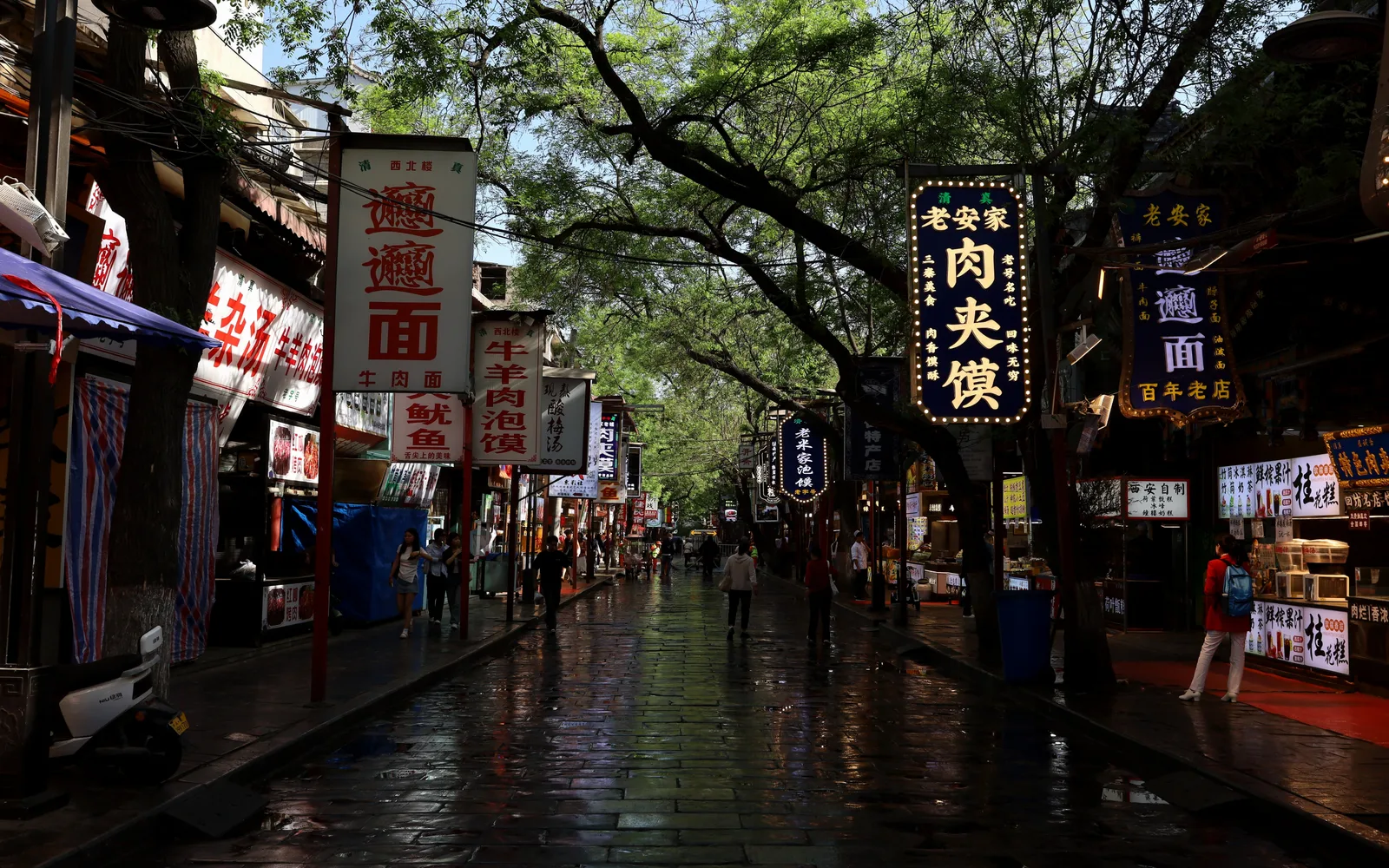
China is easy for Muslim travellers in some places and hard in others. Halal food, marked 清真 (qīngzhēn), is everyday food in Xi’an’s Muslim Quarter, Beijing’s Niujie and across the north-west, and noodle shops run by Hui Muslims exist in most cities. In mountain and scenic areas it is scarce and has to be planned. The 2026 Global Muslim Travel Index ranks China 70th of 150 destinations. Look for the 清真 sign rather than a menu without pork, and settle your own standard before you book.
Is China Muslim-friendly?
Partly. The Mastercard-CrescentRating index for 2026 gives China 44 points out of 100: 70th of 150 destinations and 30th among those outside the Organisation of Islamic Cooperation, up from 74th in 2025. It scores 70 for access and 27 for communication. On the ground, halal restaurants and mosques exist in every large city, but little will point you to them in English.
How to tell a halal restaurant: the 清真 sign
Halal restaurants show the characters 清真 on the signboard, often beside Arabic script. Most are run by Hui or Uyghur Muslims. The rules behind the sign are local. Shanghai’s regulation, as posted by the city’s Ethnic and Religious Affairs Bureau, is a clear example:
- A business must obtain a halal sign-plate (清真标志牌) from the city or district ethnic affairs authority before it may produce or sell halal food (Article 9).
- The plate hangs in a prominent place on the premises, and only plate holders may use the word 清真 on signboards and packaging (Articles 13 and 18).
- Vehicles, utensils, storage and cooking areas must be used for halal food only (Article 17).
- Customers may not bring non-halal food into a halal restaurant (Article 20).
Other cities have their own rules, and enforcement differs, so treat the sign as the first check, not the last. A restaurant that says “no pork” (不含猪肉) is making a different and weaker claim.
Four standards people mean by “halal”
| Standard | What it is | Where you find it |
|---|---|---|
| Licensed or certified halal | Premises that hold a 清真 sign-plate or a certificate, run by Muslims | Hui neighbourhoods, the north-west, and some restaurants in most cities |
| Muslim-run, no paperwork you can check | Family noodle and kebab shops that show 清真 on the sign | Everywhere, including small towns |
| No pork, no lard | An ordinary kitchen leaves pork out on request. Woks are shared and cooking wine may be used | Ordinary restaurants and hotels |
| Vegetarian or seafood fallback | Avoids meat. Cooking wine and shared oil are still possible | Anywhere |
JAKIM, Malaysia’s halal authority, defines halal by ingredients, preparation, equipment and storage, not by the absence of pork alone. Decide which of the four you accept, and for which meals, before you book.
Words to show in a restaurant
- To ask whether it is a halal restaurant: 请问这里是清真餐厅吗?
- To state your standard: 我是穆斯林,只吃清真食品。
- For a no-pork, no-lard meal in an ordinary kitchen: 我不吃猪肉和猪油,做菜请不要放料酒,请用干净的锅。
Where it is easy and where it is hard
| Place | Halal food | Mosque |
|---|---|---|
| Xi’an | The Muslim Quarter beside the Drum Tower is a whole district of halal restaurants and street food | The Great Mosque in Huajue Lane, inside the quarter |
| Beijing | Niujie, the Hui neighbourhood near the centre, has halal butchers, snack stalls and restaurants | Niujie Mosque, about a thousand years old |
| Gansu and Xinjiang, on the Silk Road | Halal restaurants are the norm in Lanzhou, along the Hexi Corridor and across Xinjiang | In the cities along the route |
| Quanzhou | A port city with Islamic heritage from the Song and Yuan periods | Qingjing Mosque, 11th century, part of the UNESCO World Heritage listing |
| Shanghai, Chengdu, Guangzhou and other large cities | Halal restaurants exist but are spread out. Plan each meal around the day’s route | Each has at least one |
| Zhangjiajie and other scenic areas | Scarce. One resort hotel in Zhangjiajie lists a Muslim restaurant with halal cuisine; otherwise plan every meal in advance | Check before you book |
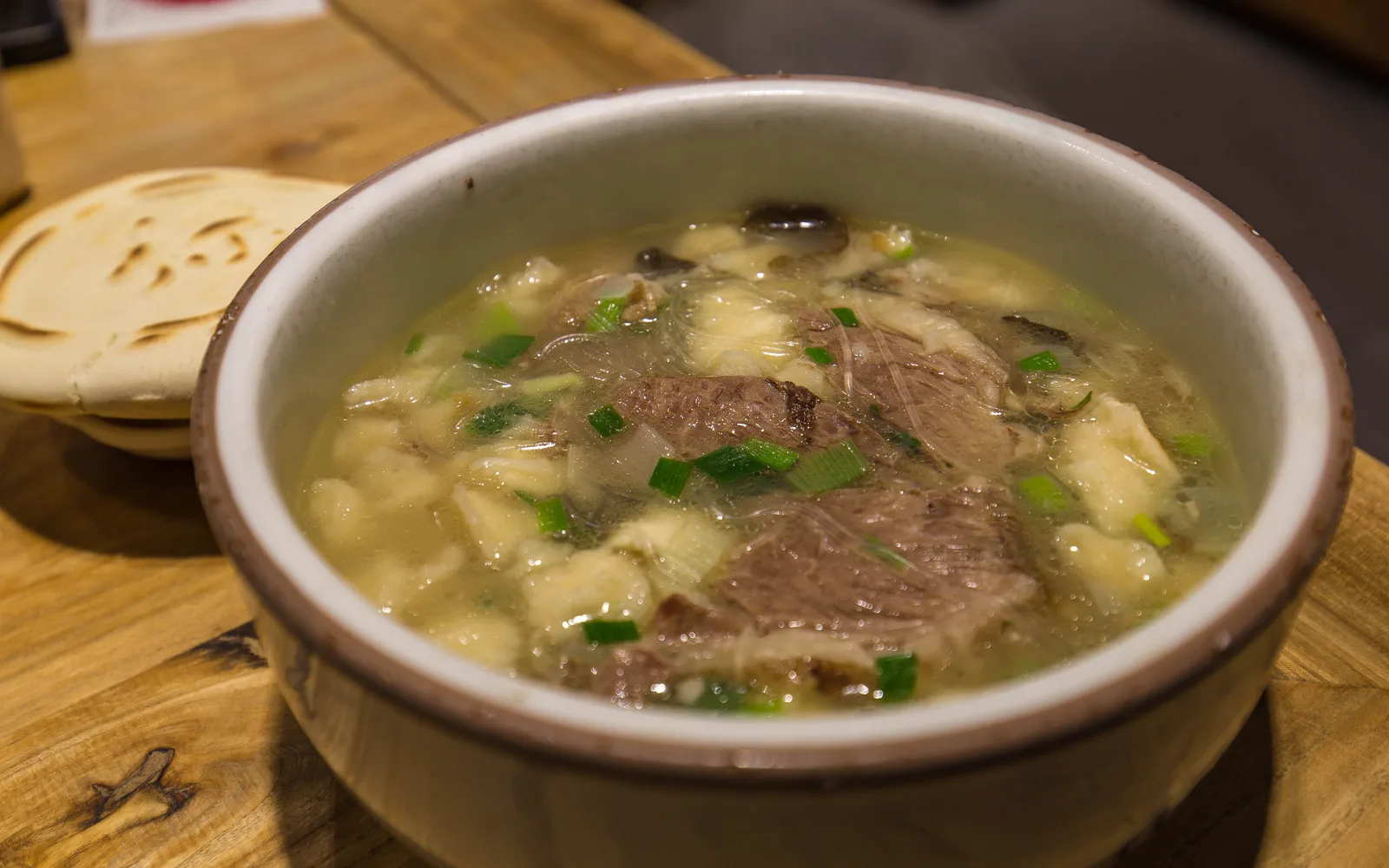
Flights, trains, hotels, ships and prayer
- Flights: Air China describes its Muslim meal (MOML) as free of pork, animal fats and alcohol, with meat prepared in the halal tradition, and asks for the request at least 24 hours before departure. China Southern asks for 24 hours on flights from mainland China and 48 hours from elsewhere.
- Trains: no halal meal is guaranteed on board. Eat before you travel or bring food.
- Hotels: breakfast buffets are mixed and serve pork. If you need a halal breakfast, say so before the hotels are chosen.
- Yangtze ships: meals come from one shared kitchen. Ask what the ship can serve before you book the cruise.
- Prayer: mosques are in the cities, not in the scenic areas. Give your guide your prayer times and the day’s stops are planned around them.
How we plan a private tour for Muslim travellers
- Before we quote, we ask which standard you keep: licensed halal restaurants only, Muslim-run restaurants, or no pork and no lard.
- Lunch and dinner can be added as a meal plan at restaurants that show the 清真 sign, or left open to choose each day with the guide. We mark the days where none is near the route.
- Hotel breakfast is included and is not halal. If that matters, we look for a hotel that can meet it or plan breakfast outside.
- Meals supplied by third parties, such as a Yangtze ship, are checked with the supplier and confirmed to you in writing before you pay.
- We are a licensed Chinese travel agency, not a halal certification body. We tell you what a restaurant displays and claims; we do not certify it.
Halal and Muslim travel in China: questions
Is China Muslim-friendly?
In the cities with Hui communities, yes: Xi’an, Beijing’s Niujie and the north-west have halal food and mosques close together. Elsewhere it takes planning. The 2026 Global Muslim Travel Index ranks China 70th of 150 destinations.
Is there halal food in China?
Yes. Restaurants marked 清真 are found in most cities, most often beef-noodle and lamb restaurants run by Hui Muslims.
Is halal food easy to find in China?
Easy in Xi’an, Beijing and the north-west, possible in every large city, and scarce in mountain and scenic areas such as Zhangjiajie.
Which part of China is most Muslim-friendly?
The north-west: Xi’an, and Gansu, Ningxia, Qinghai and Xinjiang, where Hui and Uyghur communities are large.
How do I know a restaurant in China is halal?
Look for 清真 on the signboard. In Shanghai a restaurant must hold a halal sign-plate issued by the ethnic affairs authority to use the word. “No pork” is not the same claim.
Is there halal food in Zhangjiajie?
Very little. One resort hotel lists a Muslim restaurant with halal cuisine. Otherwise the realistic choices are a no-pork, no-lard arrangement or vegetarian dishes, which are weaker standards, so plan each meal before you go.
Can I get a halal meal on a flight to China?
Air China and China Southern take Muslim meal requests at least 24 hours before departure from mainland China; China Southern asks for 48 hours from other countries.
Is vegetarian food in China halal?
Not automatically. It avoids meat, but cooking wine is common in Chinese kitchens and woks are shared. Ask for no cooking wine (不放料酒) as well.
Do your tours include halal meals?
They can. With the meal plan, lunch and dinner are included at restaurants that show the 清真 sign, and its price is in your written quote. We tell you what each restaurant displays; we do not certify food.
Sources(8)
- Global Muslim Travel Index 2026: ChinaMastercard-CrescentRating
- Shanghai Regulations on the Administration of Halal Food (Chinese)Shanghai Ethnic and Religious Affairs Bureau
- Official halal guidanceJAKIM, Department of Islamic Development Malaysia
- Special meals: the Muslim meal (MOML) and the 24-hour request ruleAir China
- Meal reservation rulesChina Southern Airlines
- Quanzhou: Emporium of the World in Song-Yuan China (inscribed 2021)UNESCO World Heritage Centre
- Seven halal dishes to try in Niujie, Beijing’s central Muslim neighbourhood (13 August 2026)The National
- Howard Johnson Neodalle Resort Zhangjiajie: diningWyndham Hotels & Resorts