Chongqing
Dazu Rock Carvings
Mostly Buddhist cliff carvings from the Tang to the Song, a World Heritage site
Why it's worth the trip
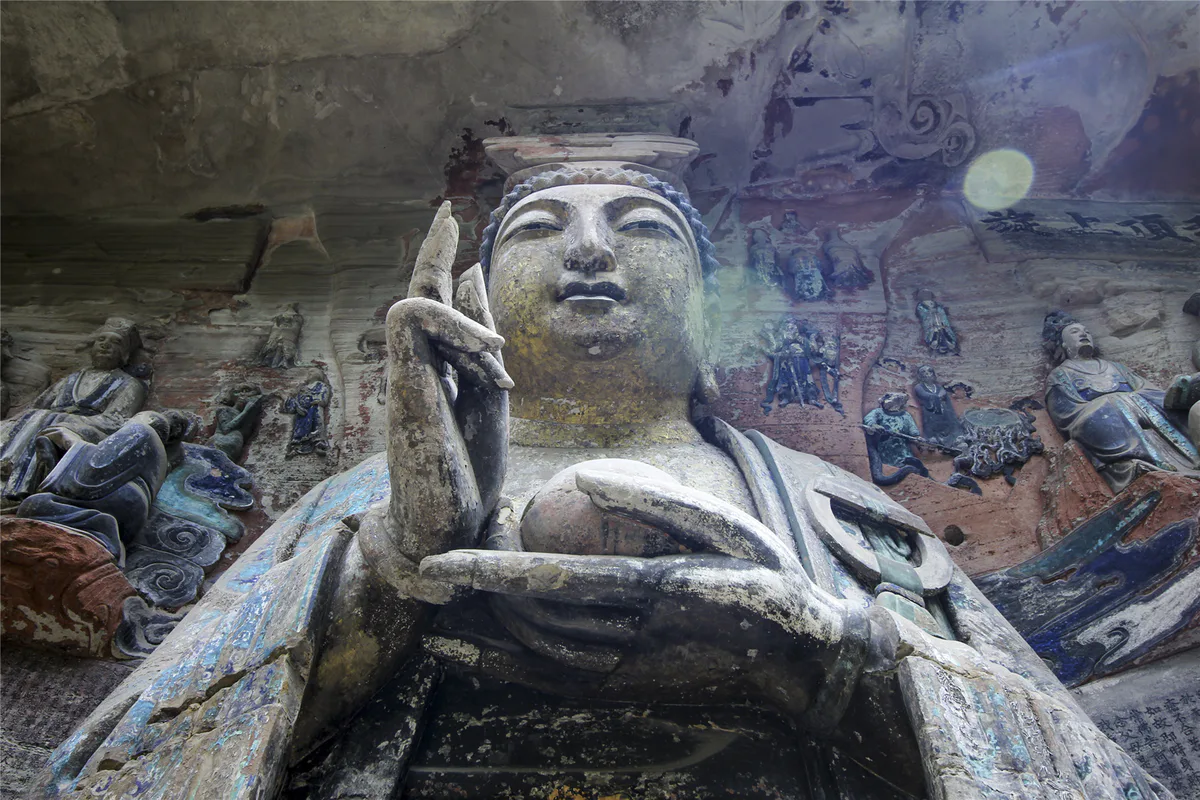
Walk into the horseshoe-shaped valley at Baodingshan and the cliff around you is carved for some 500 metres, scene after scene, like a picture book in stone. Three figures seven metres tall lean forward to look down at you. One holds up a stone pagoda as tall as a man; a fold of his robe, falling from forearm to knee, takes the weight. Round a corner, a golden Guanyin, the goddess of mercy, sits amid 830 hands fanned across the rock like a peacock's tail. Further on, a Buddha 31 metres long lies on his side, eyes almost closed, his lower legs vanishing into the cliff. Early surveyors wrote that his head was as big as a house.
It reads like a book because it was planned as one. From the 1170s, a local monk, Zhao Zhifeng, spent some 70 years having the valley carved as one long sermon for ordinary people. Words run beside the scenes, and no subject is told twice. Much of it is everyday life. Parents raise a child across ten scenes. A farm woman lifts the lid of her coop, the hens scramble out, and two squabble over a worm. There are drunk men and women, and herd boys with their oxen. One line spells it out: of three thousand laws, failing your parents is the worst crime. Look for a curly-haired monk in several scenes; scholars mostly take him to be Zhao.
Of Dazu's five main carving sites, two are the ones to see. Baodingshan holds the great set pieces, so if you have time for one site, make it this. Beishan, on a hill just north of Dazu town, was begun nearly three centuries earlier and is quieter. Its smaller niches crowd the cliff like a honeycomb, each finely cut, with so many figures of Guanyin that it is called a gallery of them. Compared with Leshan's single giant, Dazu is a place to walk slowly and look at faces up close.
Don't miss
The spring that bathes the baby Buddha
Beside the reclining Buddha, nine dragon heads burst from the rock. Water runs all year from the mouth of the central one onto the infant Buddha below, who sits with palms together for his first bath. The carvers collected the hillside's rainwater in a pool and led it through hidden channels to the dragon's mouth. From there it winds away along a zigzag channel in front of the reclining Buddha.
The shaft of light in Yuanjue Cave
Step into Yuanjue Cave, 12 metres deep. A window cut above the entrance sends a shaft of daylight into the middle, where a figure kneels, head bowed and palms together, before three Buddhas. Twelve more figures sit along the walls in robes that look like silk. When the cave falls quiet, you may hear a drip: water seeping through the rock falls from a carved dragon's mouth into an old monk's bowl.
Beishan's Guanyin with prayer beads
At Beishan, look for niche 125, a small Guanyin with her hands crossed at her waist around a string of prayer beads. Her thin robe clings, her ribbons lift as if in a breeze, and she seems about to smile. Then visit cave 136, the Revolving Sutra Cave. You don't walk in: you look in over a waist-high wooden rail across the mouth, which replaced a metal grille in 2025. The cave faces west, and on a sunny afternoon light can slant in past the stone scripture case at its centre and fall on the figures. Step slowly along the rail and different figures slip out from behind the case.
Fitting it in
- Time to give it
- About two hours each way by road from central Chongqing. Allow two to three hours for the carvings at Baodingshan, more if you want the museum beside it, and one to two hours at Beishan. The two together fill the day.
- When to go
- Spring and autumn are the comfortable seasons. The carvings line open cliffs and Chongqing summers are hot and humid, so in July and August start early. Go on a weekday if you can, and avoid the May Day and National Day holidays, when it is at its busiest. Conservation work sometimes screens part of the cliff, so we check before you go.
- Pair it with
- See Baodingshan in the morning, have lunch in Dazu town and spend the afternoon at Beishan; the two are 20 to 30 minutes apart by car. If you are joining a Yangtze cruise, Dazu fits the day you embark: carvings by day, then back to Chongqing to go aboard in the evening.
- Who can skip it
- If you came to Chongqing for the city and have only two or three days, keep them there. Dazu costs a whole day, about four hours of it in the car. If Leshan is already on your route and you want one giant Buddha, Leshan is the bigger single sight. Dazu is for people who like to look closely. And if sculpture leaves you cold, a day on the road for it is hard to justify.
Questions travellers ask
Are the Dazu Rock Carvings worth visiting?
Yes, if you enjoy art or stories. Carved between the 9th and 13th centuries, the cliffs hold a 31-metre reclining Buddha alongside farmers, drunkards and parents raising a child. UNESCO, which listed Dazu in 1999, singles out ‘the light that they shed on everyday life’ in China at the time. Allow a full day from Chongqing, with two to three hours at Baodingshan.
Baodingshan or Beishan: which should I visit?
Choose Baodingshan if you have time for one. It holds the Thousand-Hand Guanyin, the reclining Buddha and some 500 metres of carved valley. Add Beishan if you love sculpture. It was begun nearly three centuries earlier, it is quieter, and its cliff is crowded with finely cut figures of Guanyin. The two are 20 to 30 minutes apart by car and have separate tickets.
Can you visit Dazu as a day trip from Chongqing?
Yes. It is about two hours each way by road, so it fits one day. Spend two to three hours at Baodingshan, then an hour or two at Beishan if you want both. Leave early, because the drive takes about four hours of the day.
Dazu Rock Carvings or the Leshan Giant Buddha: which should I choose?
Choose Leshan for one overwhelming sight: a single Buddha 71 metres tall, seated by the river, a day out from Chengdu. Choose Dazu for detail and stories: thousands of figures you see up close, a day out from Chongqing. If you have time for both, they make two very different days.
When is the best time to visit Dazu?
Spring and autumn, roughly March to May and September to November, are the most comfortable. July and August are hot and humid on the open cliffs, so go early in the day. Avoid the May Day and National Day holidays, and go on a weekday if you can.
Sources: UNESCO World Heritage Centre: Dazu Rock CarvingsDazu District government: Zhao Zhifeng and the Baodingshan carvings (2022)Dazu District government: the reclining Buddha and the Nine Dragons (2023)Xinhua: the Thousand-Hand Guanyin restored (2021)Chongqing Municipal Commission of Culture and Tourism Development: 北山摩崖造像 (Beishan)Dazu News: cave 136 at Beishan gets a waist-high wooden rail (2025)CNR Chongqing: Beishan cave 136's iron gate comes off (2025)
Private tours that include it
All private tours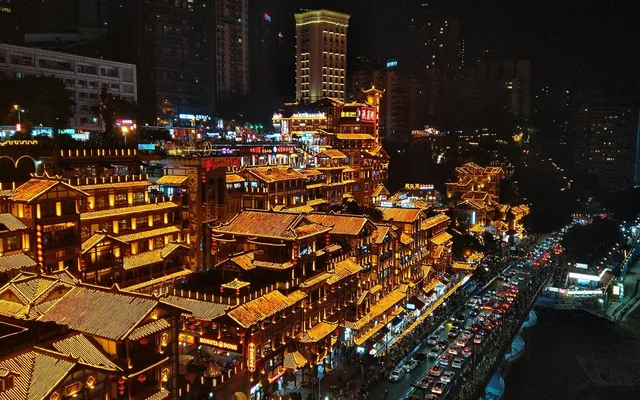
Chengdu, Leshan, Chongqing, Wulong & Dazu: 8-Day Private Tour
Chengdu · Leshan · Chongqing · Wulong · DazuTravellers who want Sichuan culture, a riverfront megacity and karst mountain scenery in one trip.Itinerary & price- Want a different trip?Tell us your days and cities, and we'll plan the trip around you.Plan it with us
Photo (cropped and resized): Chengdu, Leshan, Chongqing, Wulong & Dazu: 8-Day Private Tour (Jonashtand, CC BY-SA 4.0)
More in Chongqing

Want us to arrange it?
Hand us the whole trip and we will fit it in.