
Broken Bridge, Leifeng Pagoda and Jinshan Temple are real places, but none proves that the White Snake story happened as history. Broken Bridge is a maintained element of West Lake. Beneath the present Leifeng tower are remains of a Buddhist pagoda from the late Wuyue period; the visitor building is modern. Jinshan is a living Buddhist temple whose flood association belongs to the legend’s literary and theatrical growth. For most readers, Hangzhou supplies enough evidence in one focused half-day. Add Zhenjiang only if comparing how two cities made a changing story visible is worth an extra stop.
Why does one legend belong to both Hangzhou and Zhenjiang?
The legend did not emerge as a fixed itinerary. National ICH records separately register Hangzhou and Zhenjiang projects and name both important transmission areas. Hangzhou’s record emphasizes West Lake and Leifeng; later landscape-narrative research, not registration alone, documents Jinshan’s specific attachment. Together the evidence supports multi-place transmission, not an origin contest. Storytellers, playwrights and screenwriters reorganized places for their versions. This literary geography shows where communities located the story, not where evidence proves Bai Suzhen, Xu Xian or Fahai lived.
| Layer | What belongs here | What it can establish |
|---|---|---|
| History and material evidence | Bridge repair, pagoda foundations, Buddhist objects, dated construction, destruction and conservation | A place or object existed and changed; not that a legendary episode occurred |
| Folklore | Bai Suzhen, Xu Xian, Fahai and local place associations | A story circulated and mattered in a community; not verified biography |
| Literature and performance | Named written versions, drama and opera that add, remove or enlarge episodes | What a particular version says; not one timeless master plot |
| Tourism presentation | A modern tower, relief, exhibition, festival or renamed feature | How the story is presented now; not ancient fabric or event proof |
The familiar plot was assembled over time
Early snake-woman material does not yet supply the romance most viewers recognize. The national heritage overview identifies Feng Menglong’s seventeenth-century story, commonly translated as ‘Madam White Is Imprisoned Forever beneath Leifeng Pagoda,’ as an early relatively complete literary milestone. Later drama continued changing motivation, sympathy and place. Qing theatre enlarged scenes now treated as essential, including flooding Jinshan and the Broken Bridge encounter after the conflict. Modern screen works and attractions made another selection. Ask ‘Which version contains this scene?’ rather than ‘Where did the original event happen?’
| Stage | Useful conclusion | Do not assume |
|---|---|---|
| Early snake-woman stories | Older motifs existed before the familiar West Lake romance | Every modern character and location was already fixed |
| Feng Menglong’s story | A major written version organizes a stronger Hangzhou–Suzhou–Zhenjiang–pagoda geography | All later-famous scenes already had their final form |
| Later theatre and opera | Performance traditions expanded reconciliation, conflict, flooding and bridge scenes | One stage script represents every region or period |
| Film, television and attractions | Modern media made selected faces, costumes and episodes widely recognizable | The most familiar screen version is the oldest or only version |
At Broken Bridge, the place is real but the meeting is story memory
Start with the bridge as landscape evidence. ICOMOS places Broken Bridge at the eastern end of Bai Causeway and records a history of maintenance and repair within the deliberately shaped West Lake cultural landscape. Look at the bridge’s junction with the causeway, its current stone fabric and its relationship to the lake. Then turn toward the south shore: Leifeng is not the next object on a compact story street. The real separation helps correct a screen-shaped illusion in which every episode sits within a few steps. The bridge can anchor the legend without being an untouched prop from a historical meeting.
At Leifeng, separate the old foundation, the lost tower and the new building
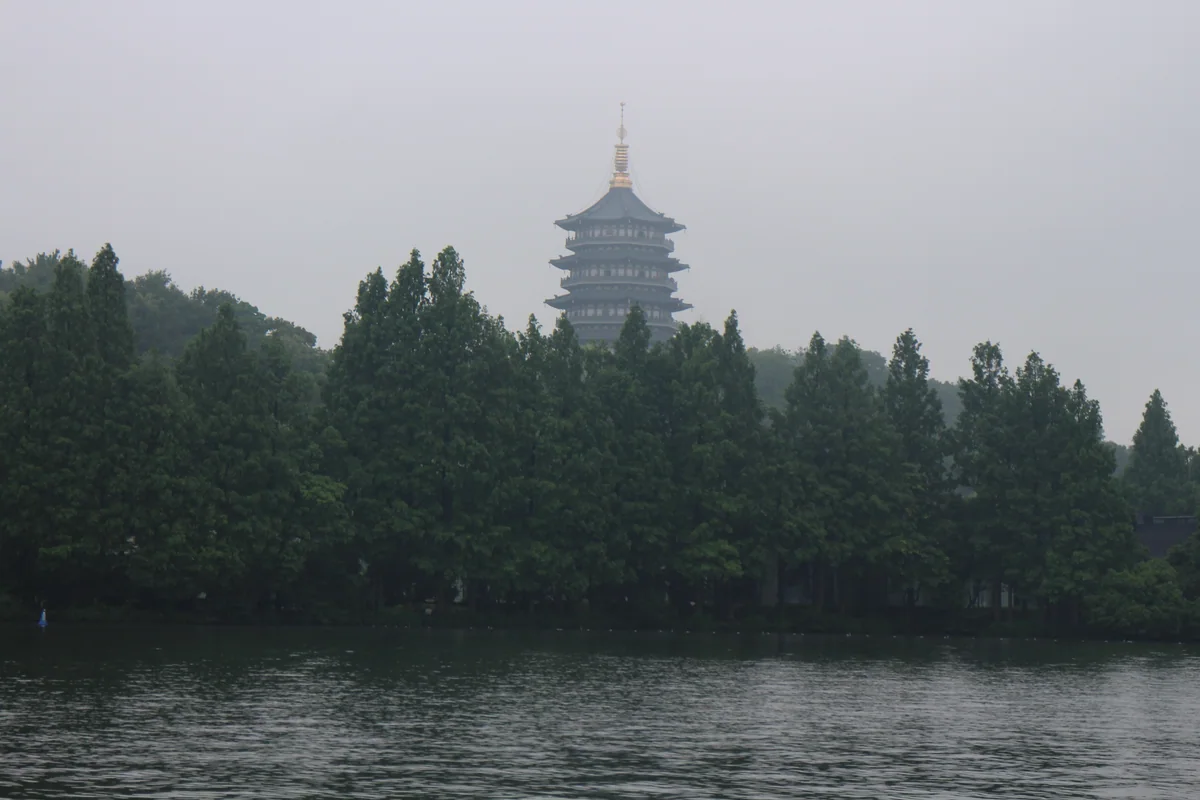
The strongest old evidence at Leifeng is Buddhist, not biographical. The late-Wuyue pagoda was built for religious purposes, and excavation in 2000–2001 documented its foundation, underground chamber and Buddhist deposits. The damaged historic tower collapsed on 25 September 1924. The present visitor building was then constructed over the protected site in the early twenty-first century. Read its silhouette as modern historicizing architecture and its circulation system as protection and interpretation—not as the Wuyue tower surviving intact.
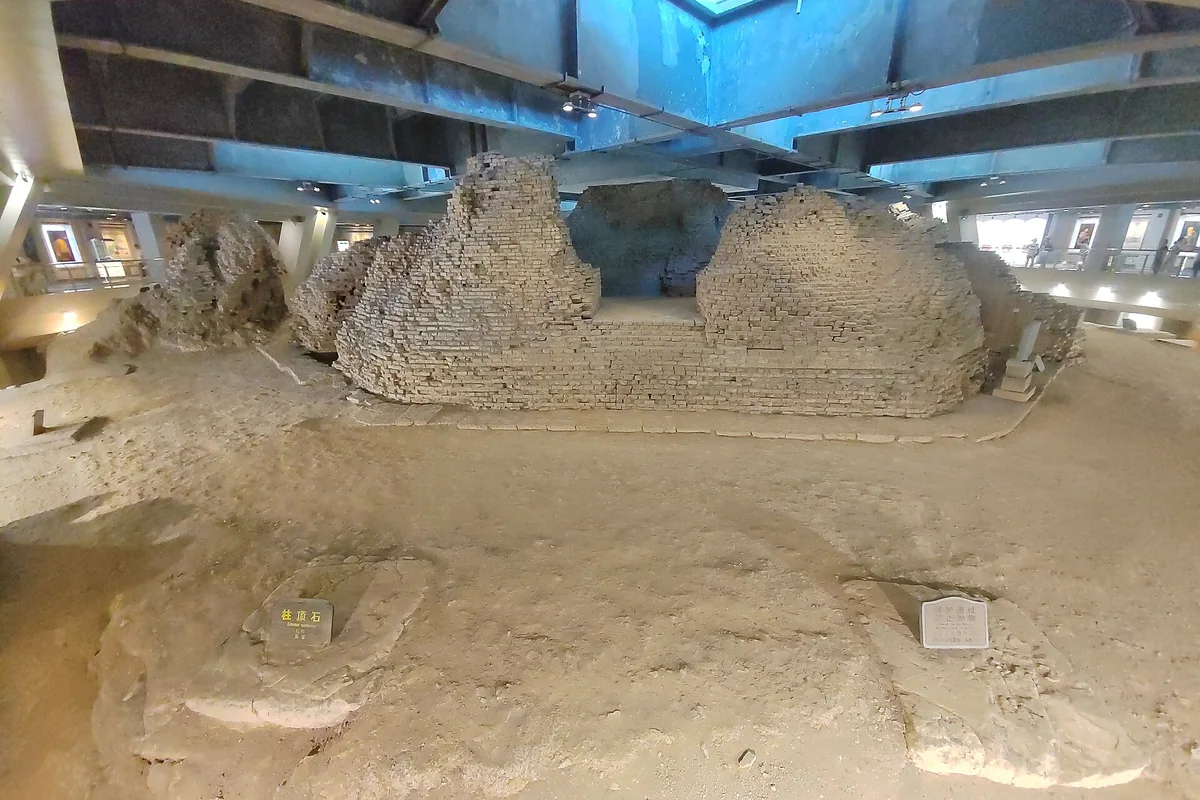
If that interior floor is accessible, look for the old brick base and its modern protection boundary. This contrast is more useful than searching for a legendary prison. Archaeology establishes construction, Buddhist use, collapse and deposits; it cannot identify Bai Suzhen. The underground chamber matters archaeologically, but this guide promises neither viewing nor entry. Objects may rotate, so confirm floor access and displays before planning around one relic.
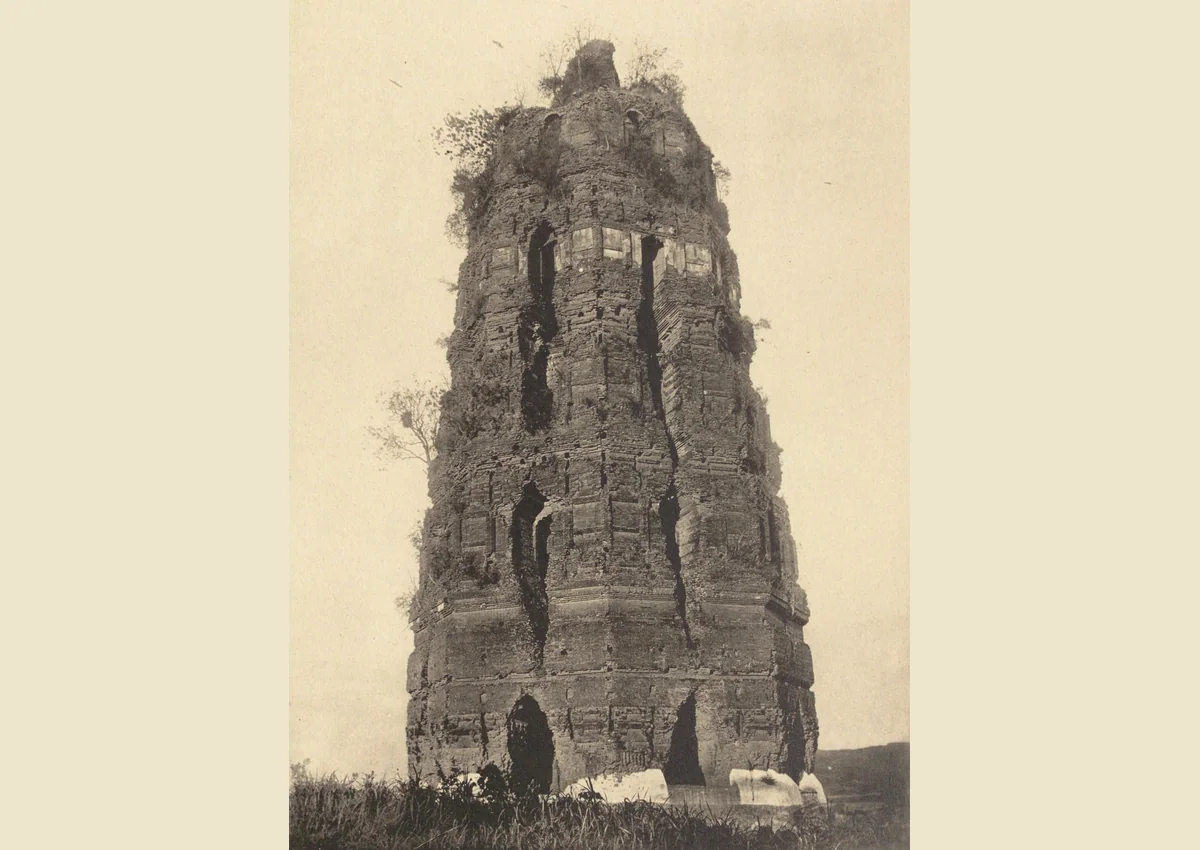
A rights-cleared pre-collapse photograph adds the missing middle layer. Compare its damaged masonry mass with the present roofed outline: neither should be mistaken for the other. The photograph documents the old tower’s late condition, not its appearance when first built. Where current displays include reliefs, murals or White Snake scenes, they make a modern editorial choice about which version visitors will remember. Treat any such display as interpretation even when it stands above authentic foundations.
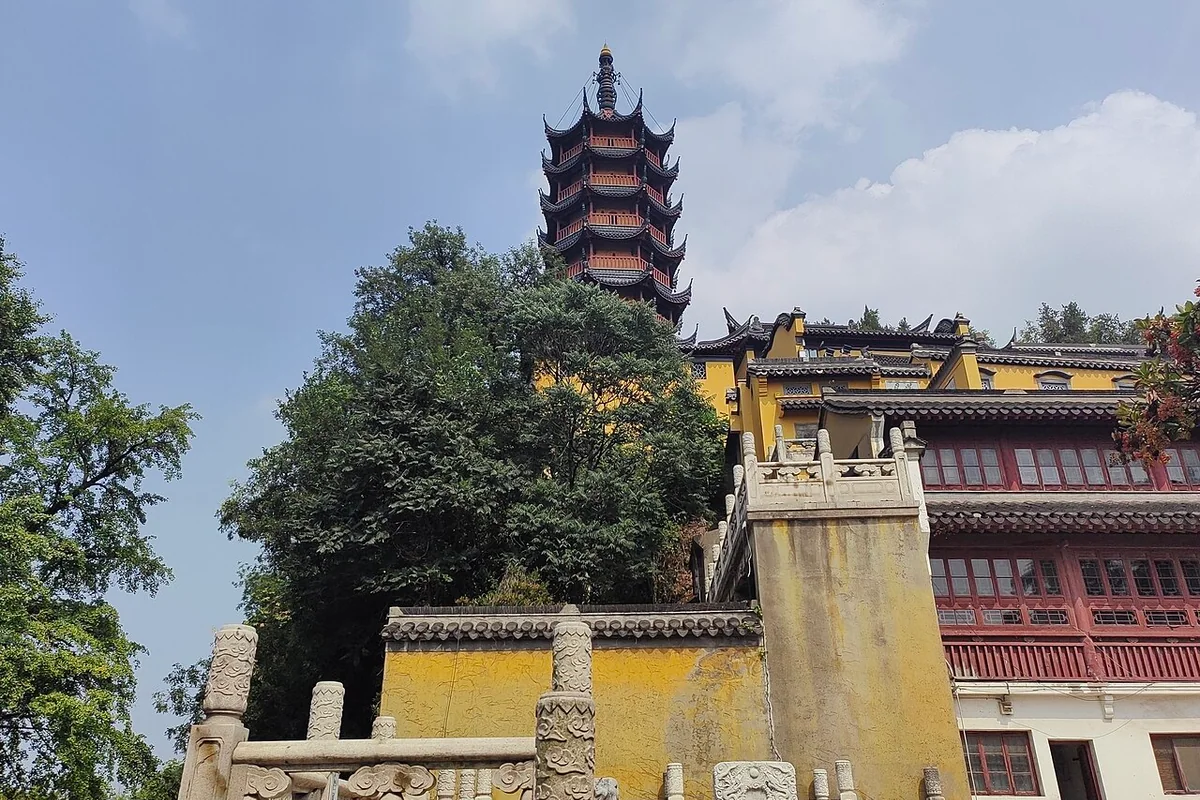
Jinshan adds a living temple and a different way of attaching story to place
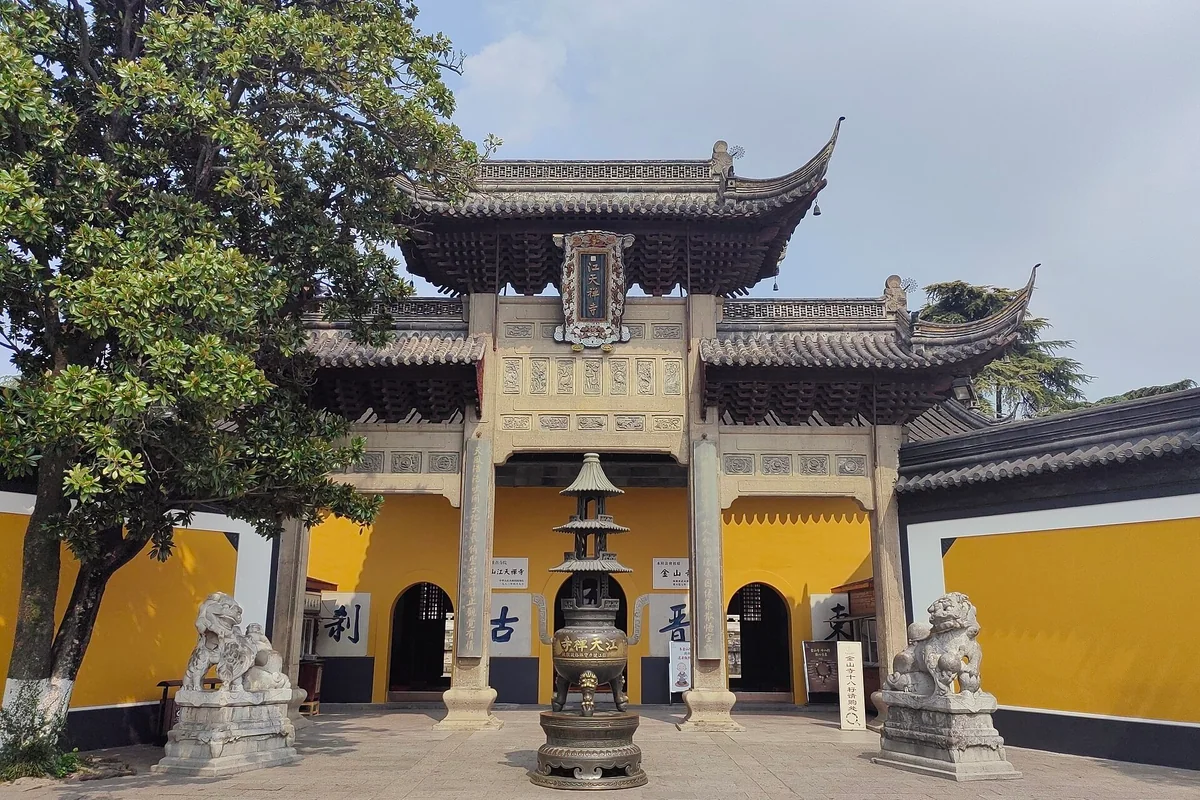
Jinshan, formally Jiangtian Chan Temple, should first be read as an active Buddhist institution. Temple use, worshippers and restricted areas take priority over its role in White Snake tourism. The uphill arrangement also creates a real mobility cost that a flat story map hides. A 2026 fire-service report, describing a local museum display, says a 1948 fire damaged more than 300 historic rooms or buildings; without a stronger archive in this source pack, that number remains attributed rather than stated as an independent primary fact. It is still enough to warn against calling the present complex wholly ancient fabric.
A scholarly temple history and historical-geography research support a cautious geographical statement: nineteenth-century channel change and sedimentation progressively altered Jinshan’s island–shore relationship, and the hill is now joined to land. Sources do not justify turning one precise joining year into an evergreen fact. More importantly, physical change cannot prove the literary flood. Use today’s water-and-hill view to understand why the scene became imaginable, not to reverse a theatrical episode into hydrological history.
What does each site actually let you claim?
| Place | Strongest evidence | Story layer | Modern presentation |
|---|---|---|---|
| Broken Bridge | A maintained bridge in the West Lake cultural landscape | Meeting and reunion associations | Current signs, guided narratives and photo framing |
| Old Leifeng site | Foundation, brick base, underground chamber record and Buddhist finds | Imprisonment beneath the pagoda | Protected ruin and archaeological explanation |
| Present Leifeng tower | A modern building over a protected site | White Snake scenes selected for display | Architecture and visitor route; reliefs or murals only if currently displayed |
| Jinshan / Jiangtian Temple | A living Buddhist complex with documented rebuilding and changing geography | Flooding Jinshan and later Fahai associations | Cave naming, attraction events and contemporary interpretation |
Is Hangzhou enough, or should you add Zhenjiang?
Choose by the question you want the trip to answer
Hangzhou only
- Best for a first encounter with the legend’s most legible bridge–pagoda geography
- Shows a real landscape feature, an excavated old site and a modern reconstruction in one city
- The sensible default when Zhenjiang would be a detour or create a rushed transfer day
Add Zhenjiang
- Worthwhile when Jiangsu already fits the route and Jinshan can receive a separate half-day
- Adds a living temple, hillside movement and evidence of later place naming
- Best for readers comparing how literature becomes landscape, not for proving an origin
Skip both as a story project
- Appropriate if the main interest is ordinary West Lake sightseeing rather than version history
- Better for travellers who cannot use the uphill Jinshan route and do not value the comparison
- Do not spend another city stop simply because a film scene used the name
Before adding Zhenjiang, count usable time rather than train minutes: checkout, station access, security, waiting, local transfer, luggage and missed-connection consequences. Search 12306 for the actual date and stations; this article freezes no timetable or inventory. If the comparison cannot keep an independent half-day after those costs, Hangzhou is enough.
Use one half-day in each city to reveal the layers
- Begin at Broken Bridge. Locate the Bai Causeway junction and label the bridge as maintained landscape before discussing the meeting scene.
- Use one short public lakeshore orientation to establish the real separation between the bridge area and Leifeng. This is evidence work, not a full West Lake walk or cruise plan.
- Approach the present Leifeng tower from outside and identify its modern silhouette before entering.
- If current floor access allows, find the old brick base and conservation boundary. Do not promise the ruin, excavated underground chamber or a rotating museum object before rechecking.
- If a relief or story label is currently displayed, finish there. Ask which version it selects and what material evidence it does not provide.
- At the entrance, record both names—Jinshan Temple and Jiangtian Chan Temple—and remember that the religious institution is not a legend-themed set.
- Assess the stairs before committing to upper areas. Keep a lower public-space fallback for limited mobility, heat, rain or crowd control.
- Read current halls and repairs without assigning the whole complex an early founding date. Give worship and resident access priority.
- Keep Cishou Pagoda separate from Hangzhou’s Leifeng Pagoda, then use a public viewpoint to read hill, river and modern land connection.
- Only approach the Fahai/Peigong cave area if current signs and staff confirm access. If not, the naming history remains understandable without entry.
Do not mistake a complete-looking story for complete evidence
| Shortcut | Correction |
|---|---|
| The real bridge proves the meeting | A real named place can carry folklore without documenting an event |
| UNESCO means every visible structure is original | The listing recognizes a developed cultural landscape with components that have changed |
| Today’s Leifeng is the Wuyue tower | The visitor building is modern; the protected old site is the material evidence |
| The old photograph shows the first tower | It shows a damaged late condition before the 1924 collapse |
| Jinshan’s present halls all date from its founding | Fire, rebuilding, repair and active use require building-by-building evidence |
| Fahai Cave proves a historical resident | Changing names show later association and tourism presentation |
| The film plot is the ancient master version | Named written and theatrical versions developed the familiar geography over time |
If a tower, cave or connection fails, the comparison can still work
| Failure | Keep | Remove |
|---|---|---|
| Leifeng interior is closed | Broken Bridge, exterior modern tower and a sourced old/modern comparison | Claims that the ruin or underground chamber can be seen |
| A museum object is off display | Its excavated provenance as a sourced fact | A promise to find it in a gallery |
| Fahai/Peigong cave access or wording is unclear | Documented naming history and public temple route | Entry, sign text and photography promises |
| Jinshan upper route is unsuitable | Lower public fabric and a confirmed viewpoint | A forced climb or claim that the visit is incomplete |
| Rail or onward connection is fragile | The complete Hangzhou evidence sequence | Zhenjiang as a rushed label-collecting detour |
Who gains most from this story line?
Choose it if you enjoy folklore, adaptation, archaeology or the way cities turn literature into visible landscape. Hangzhou alone suits most first-time visitors and anyone protecting pace. The two-city version suits a reader already moving through Zhejiang and Jiangsu who wants to compare two kinds of evidence. Skip the Zhenjiang addition if stairs, transfer risk or limited time outweigh that specific comparison. The useful souvenir is not a verdict on the ‘true birthplace’; it is the ability to name what is material, what is narrated and what was built to interpret the narration.
Questions readers ask about these sites
Does Broken Bridge prove that Bai Suzhen and Xu Xian met there?
No. It proves that a named, repaired bridge belongs to West Lake's long-developed landscape, at the eastern end of Bai Causeway. The association with meeting or reunion belongs to folklore and later literature. UNESCO status does not authenticate the characters, and it does not mean every visible stone is ancient.
Is the Leifeng Pagoda I can walk into the original tower?
It is a modern building. The damaged historic tower collapsed on 25 September 1924, and what visitors enter today was built over the protected site in the early twenty-first century. Beneath it are remains of a late-Wuyue Buddhist pagoda, whose foundation, underground chamber and Buddhist deposits were documented in the 2000–2001 excavation. The old-looking silhouette cannot carry the Wuyue date over to the new tower.
Is the version I know from film and television the original story?
The story you know was assembled in stages. National intangible-heritage material treats Feng Menglong's seventeenth-century telling as an early fuller written version; later opera kept changing motives and places; the Qing stage expanded the flooding of Jinshan and the Broken Bridge reunion; film and television selected again. Ask which version a scene belongs to, rather than where the original event happened.
Is Jinshan still an island in the river?
No, the hill is now joined to land. A scholarly temple history and historical-geography research support a cautious statement that nineteenth-century channel change and sedimentation progressively altered Jinshan's island–shore relationship. The sources do not justify turning one precise joining year into an evergreen fact, and physical change cannot prove the literary flood.
Can I go inside Fahai Cave at Jinshan?
Do not count on it; this guide does not promise entry. Access, wording and photography rules for 2026 have not been confirmed. Research traces how Peigong Cave and Fahai Cave were named differently over time, which shows how landscape storytelling formed rather than anything about Fahai's life. If it is closed or unclear, use public temple buildings, Cishou Pagoda and a lawful water–hill viewpoint instead.
How hard is the walk at Jinshan Temple?
The route goes uphill, and that creates a real mobility cost a flat story map hides. Look at the stairs before committing to the upper areas, and keep a lower public-space fallback for limited mobility, heat, rain or crowd control. Jinshan is formally Jiangtian Chan Temple, so temple activity, worshippers and restricted areas come before its White Snake role.
Heritage, archaeology, temple and research sources(22)
- White Snake legend — Hangzhou recordChina Intangible Cultural Heritage Digital Museum
- White Snake legend — Zhenjiang recordChina Intangible Cultural Heritage Digital Museum
- West Lake Cultural Landscape of HangzhouUNESCO World Heritage Centre
- ICOMOS evaluation of the West Lake Cultural LandscapeICOMOS / UNESCO
- Leifeng Pagoda history and protected ruinsHangzhou Culture, Radio, Television and Tourism Bureau
- Leifeng Pagoda excavation report catalogue recordNational Taiwan University Buddhist Studies bibliography / Zhejiang archaeology report
- Thematic evolution of the White Snake storyDongfang Luntan, Cui Yunwei and Sun Xubo
- Landscape narrative at Fahai Cave and Leifeng PagodaJournal of East China Normal University, Yu Hongyan
- Jinshan Jiangtian Chan TempleBuddhist Association of Jiangsu
- Zhenjiang fire-education museum report referencing the 1948 Jinshan fireJiangsu Fire and Rescue
- Jinshan Temple historyPeking University journal platform, Xu Shiyi
- Historical channel evolution of the Zhenjiang reachActa Geographica Sinica, Yang Xiao
- China Railway ticket and schedule verificationChina Railway 12306
- Hero photograph: Broken Bridge by Suicasmo, CC0 1.0; cropped, resized and converted to WebPWikimedia Commons
- Body photograph: modern Leifeng Pagoda by Suicasmo, CC0 1.0; cropped, resized and converted to WebPWikimedia Commons
- Body photograph: Leifeng Pagoda archaeological site by HoweyYuan, CC BY-SA 4.0; cropped, resized and converted to WebPWikimedia Commons
- Historical photograph: Leifeng Pagoda in 1918 by Sekino Tadashi, public domain; proportionally resized, placed on a neutral canvas and converted to WebPWikimedia Commons
- 1939 source-volume record for the 1918 Leifeng Pagoda photographNational Diet Library of Japan
- Body photograph: Jinshan Jiangtian Chan Temple entrance by Yumeto, CC BY-SA 4.0; cropped, resized and converted to WebPWikimedia Commons
- Body photograph: Cishou Pagoda by Yumeto, CC BY-SA 4.0; cropped, resized and converted to WebPWikimedia Commons
- CC0 1.0 dedication for the Broken Bridge and modern Leifeng derivativesCreative Commons
- CC BY-SA 4.0 licence for the cropped image derivativesCreative Commons
_20250505.jpg)


