
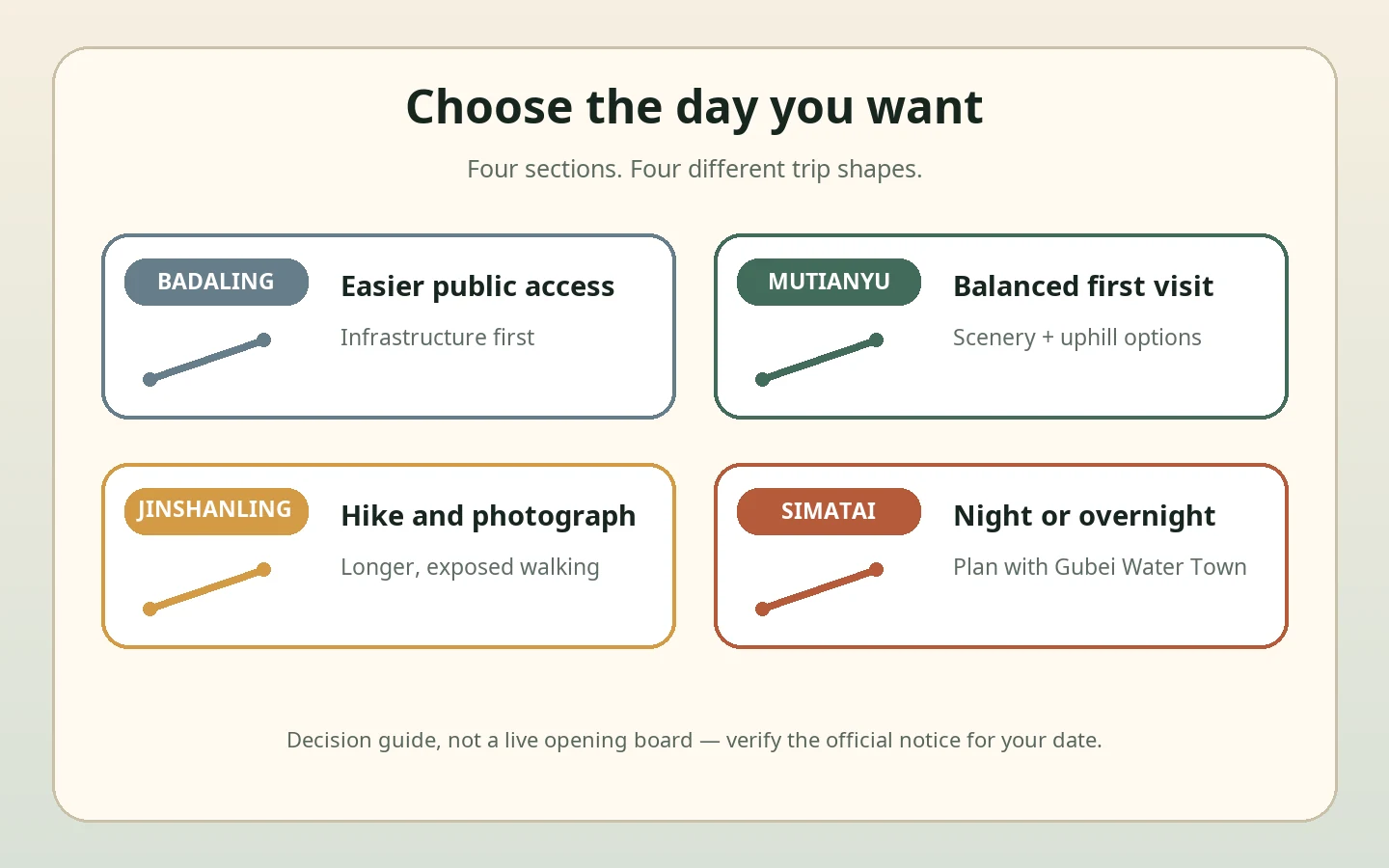
The question is not which Great Wall section is objectively best. It is whether you want the easiest independent journey, a balanced first visit, a long ridge walk or a night on the wall. Badaling, Mutianyu, Jinshanling and Simatai can all produce an excellent day, but they ask for different transport, different legs and different margins for failure. Choose the shape of the day before choosing the photograph.
Four sections, four different promises
| Section | Best fit | Effort and logistics | Main compromise |
|---|---|---|---|
| Badaling | First-time visitors prioritising the clearest independent public route; mixed-age groups that value infrastructure | Many transport choices; restored wall; walking can still be steep and the rail station itself involves substantial vertical movement | The most famous choice can also feel the most processed and crowded at popular times |
| Mutianyu | Most first trips; families; couples; visitors who want scenery with cable-car choices | Longer road journey; public transport normally includes a Huairou handoff; cable car or chairlift can reduce the ascent | ‘Quieter than Badaling’ is not a promise on weekends or holidays |
| Jinshanling | Strong walkers, photographers and travellers willing to stay nearby | Farthest and least forgiving as a casual day trip; longer exposed walking; return transport needs to be arranged before the hike | A beautiful hike can become a transport problem if treated like a simple city excursion |
| Simatai | Night-view seekers and travellers pairing the wall with Gubei Water Town or an overnight | Steep terrain; ticket and access arrangements are tied to a named day/night product and the resort system | It is a different trip shape, not a quieter substitute for Mutianyu |
Badaling: choose it for access, not because you have failed to be adventurous
Badaling is the pragmatic answer when the group needs a recognisable, heavily serviced attraction and a public journey that can be planned from several Beijing hubs. The official visitor page places it about 60 kilometres from central Beijing; the separate Homeground transfer guide compares current high-speed rail, S2 and bus routes. That range of options is real value for an independent visitor. It also concentrates demand. Arriving early on an ordinary weekday can improve the experience, but no editor can guarantee an empty wall.
Badaling works when the infrastructure solves a real problem
Good match
- Your hotel connects cleanly to the correct rail or bus hub
- The group values signed facilities and several uphill/downhill options
- You need a straightforward half- or full-day attraction rather than a remote hike
Think again
- Your only goal is solitude
- You are adding it before a tight evening flight or long-distance train
- You assume cable access removes all slopes, queues and station walking
Mutianyu: the best-balanced first visit for most groups
Mutianyu earns its default status by making several kinds of day possible. The restored wall runs through wooded ridges; the attraction publishes cable-car and alpine-slide facilities; and a visitor can choose a short scenic circuit or protect enough energy for a longer walk. The trade-off sits below the wall. Independent public transport normally requires a transfer in Huairou, while direct tourist buses and pre-arranged vehicles have their own fixed pickup and return conditions. The section is not ‘easy’ until the complete hotel-to-wall-to-hotel chain works.
Jinshanling: go because you want to walk
Jinshanling sits roughly 130 kilometres from central Beijing on the Hebei side of the municipal boundary. Its appeal is not a single viewpoint: it is the rhythm of watchtowers, restored and less-restored surfaces, repeated climbs and long views along the ridge. Recent 2026 visitor reports praise the space and walking, while also describing cold fingers at an early ticket gate and complicated independent logistics. Those reports are useful texture, not an operating notice. Treat Jinshanling as a hiking day with a fixed return or as an overnight photography plan, not as a spontaneous add-on after breakfast in central Beijing.
Simatai: choose the night-and-overnight trip, not just the wall
Simatai is the clearest choice when the wall after dark is the central memory and Gubei Water Town is an intentional part of the stay. Beijing's official material describes steep, rugged terrain and a long-running night programme; the resort publishes separate day, night, cable-car and combination products. That packaging matters. A night ticket may require resort access, and the open wall segment at night is limited. Verify the exact product, check-in window and final descent rather than assuming that a daytime wall ticket becomes a sunset ticket.
| Plan | Why it can work | What must be fixed |
|---|---|---|
| Beijing day return | Possible with a dated outbound and return | Do not combine an ambitious daytime hike, Water Town and night wall without checking every closing and departure |
| One night near the wall | Removes the late race back to central Beijing | Confirm hotel location, resort admission, luggage handling and the next day's return |
| Night wall only | A focused evening experience | Buy the exact current night product and verify whether Water Town entry and cable car are included or required |
Cable cars reduce climbing; they do not create a flat attraction
Every section involves some combination of approach walking, steps, uneven paving, gradients, queues and exposure. A cable car can remove a large ascent but usually cannot remove the distance from the drop-off, the attraction's internal shuttle, the queue, the platform or the wall itself. ‘Senior-friendly’ and ‘wheelchair-accessible’ are not safe conclusions from the presence of a lift. Ask the attraction about the exact route needed by the least mobile traveller, then shorten the wall plan before shortening the safety margin.
| Traveller | First section to test | Question that decides |
|---|---|---|
| First-time couple or friends | Mutianyu | Does the full road transfer and return fit the hotel? |
| Family with young children | Mutianyu or Badaling | Can the group reach, ascend, regroup and descend without relying on a tired child walking farther? |
| Older parent with limited stamina | Badaling or Mutianyu | What exact step-free or reduced-climb route is open on the date? |
| Serious walker | Jinshanling | Is the selected gate, exit and return transport confirmed? |
| Photographer | Jinshanling overnight | Is lawful early access current, and is bad-weather time replaceable? |
| Night-experience traveller | Simatai; or a dated Badaling/Mutianyu event | Is the night programme running on this exact date and what wall segment is open? |
Crowds belong to a date and an entrance, not permanently to a section
Badaling attracts the heaviest reputation for crowds, while Mutianyu is often sold as the quiet alternative and Jinshanling as empty. Those labels are too neat. A Golden Week morning, a school-holiday weekend, a closed cable line, a group arrival or a popular autumn ridge can change the distribution. The useful levers are a non-holiday weekday, the first workable entry, a route that moves beyond the initial cluster, and enough time to pause without blocking a narrow passage. Never step onto battlements or closed fabric for a clean photograph.
Season changes the same wall more than the marketing photograph suggests
| Season | What improves | What can fail | Better decision |
|---|---|---|---|
| Spring | Cooler walking and new foliage | Wind, variable visibility and holiday peaks | Carry a layer and do not promise blossom timing |
| Summer | Long daylight and green ridges | Heat, humidity, thunderstorms and sudden safety closures | Start early, carry water and keep the day replaceable |
| Autumn | Clearer air and strong colour when conditions align | Peak demand and no guaranteed foliage date | Choose a weekday and treat colour as a bonus |
| Winter | Sharper silhouettes and sometimes lighter demand | Exposed cold, wind, ice and reduced operations | Use footwear with grip and accept a shorter route or closure |
Night tours are events, not permanent opening hours
In 2026, Badaling published a seasonal night programme through early October, Mutianyu published separate short-holiday and summer night dates, and Simatai continued to sell a defined night product through Gubei Water Town. These are evidence that several sections can open after dark—not permission to reuse 2026 dates next year. Night access may cover only a small section of wall and may depend on a specific cable car or check-in gate. Verify the current notice, lighting time, last admission, descent and return to the hotel as one chain.
Choose the section with the hotel door included
A route labelled ‘90 minutes from Beijing’ usually starts somewhere more convenient than your hotel and stops before the wall. Compare the actual morning trip to the departure hub, security or waiting, the intercity leg, internal shuttle, uphill access, descent and last safe return. Badaling has the strongest independent public network. Mutianyu is manageable when its Huairou transfer or a dated direct bus is understood. Jinshanling needs a controlled return. Simatai makes most sense when the resort and overnight are treated as part of the route.
Two defensible first-trip shapes
Balanced day: Mutianyu
- Leave Beijing with the return already selected
- Use uphill assistance to preserve energy where it helps
- Walk one coherent section rather than chasing every tower
- Return to Beijing without a fixed evening flight or railway gamble
Walking trip: Jinshanling overnight
- Travel out the previous afternoon
- Confirm the current gate and lawful early-access rules
- Walk only the open route with weather margin
- Keep the departure transport independent of a perfect sunset or sunrise
The night-before check
- Open the chosen section's official notice and confirm it is admitting visitors on your date.
- Match the passport name and document type required by the current ticket channel.
- Write the exact Beijing departure point and the wall entrance in Chinese.
- Confirm which uphill system is operating and which wall route the group will actually walk.
- Set a leave-the-wall time that protects one verified return—not merely closing time.
- Check rain, lightning, snow, ice, wind and heat warnings; make the day replaceable.
- If a night visit is planned, verify the dated product, open towers, final descent and hotel return separately.
Questions before choosing a Great Wall section
Which Great Wall section should I choose for a first visit from Beijing?
Mutianyu is the safest default for most first trips, not because it is universally quiet, but because it balances scenery, restored walking, uphill options and a manageable Beijing day. Choose Badaling when simple public transport and extensive visitor infrastructure matter most, Jinshanling when the walk and the ridge are the point, and Simatai when a dated night visit or a Gubei Water Town overnight is part of the plan.
Can I hike from Jinshanling to Simatai?
Do not assume the through-route is open. Gates, conservation controls, temporary damage and open sections change, so an old blog describing a continuous Gubeikou–Jinshanling–Simatai walk is not a current permission. Use the current scenic-area entrance, stay on the marked public route, and ask the named operator which exit is open that day. A remote wall is cultural heritage, not an unrestricted trail network.
Does a cable car make the Great Wall suitable for someone with limited mobility?
Not by itself. A cable car can remove a large ascent but usually cannot remove the distance from the drop-off, the attraction's internal shuttle, the queue, the platform or the wall itself. 'Senior-friendly' and 'wheelchair-accessible' are not safe conclusions from the presence of a lift. Ask the attraction about the exact route the least mobile traveller needs, then shorten the wall plan before shortening the safety margin.
How far is Jinshanling from Beijing, and can I do it as a day trip?
Jinshanling sits roughly 130 kilometres from central Beijing on the Hebei side of the municipal boundary, and it is the farthest and least forgiving of the four as a casual day trip. The exposed ridge walking is longer, so fix the return transport before the hike and treat it as a full hiking day. For sunrise or sunset, a night nearby is usually more sensible than forcing a same-day return from Beijing.
Can I visit the Great Wall at night?
On dated programmes only. In 2026 Badaling published a seasonal night programme through early October, Mutianyu published separate short-holiday and summer night dates, and Simatai continued to sell a defined night product through Gubei Water Town. These are not permanent opening hours, and night access may cover only a small section of wall.
My car and driver are booked — does that mean the wall is open?
No. In August 2026 Mutianyu posted a temporary closure during a red rainstorm warning and a separate reopening notice. A driver, hotel or reseller may still have a valid transport booking when the heritage site has stopped admission, so check the attraction's own notice after severe weather and again before departure.
Sources and current operating evidence(9)
- The Great Wall World Heritage listingUNESCO World Heritage Centre
- Badaling visitor information and seasonal hoursBeijing Municipal Government
- Mutianyu official visitor information and live noticesMutianyu Great Wall Tourism Service Co., Ltd.
- 2026 Mutianyu summer night-tour noticeBeijing Municipal Government
- 2026 Badaling seasonal night-tour noticeBeijing Municipal Government
- Jinshanling attraction profileBeijing Municipal Culture and Tourism Bureau visitor portal
- 2026 Jinshanling peak-season operating noticeChengde Fabu notice republished by Sina
- Gubei Water Town and Simatai ticket productsGubei Water Town
- Simatai and Gubei Water Town visitor informationBeijing Municipal Government