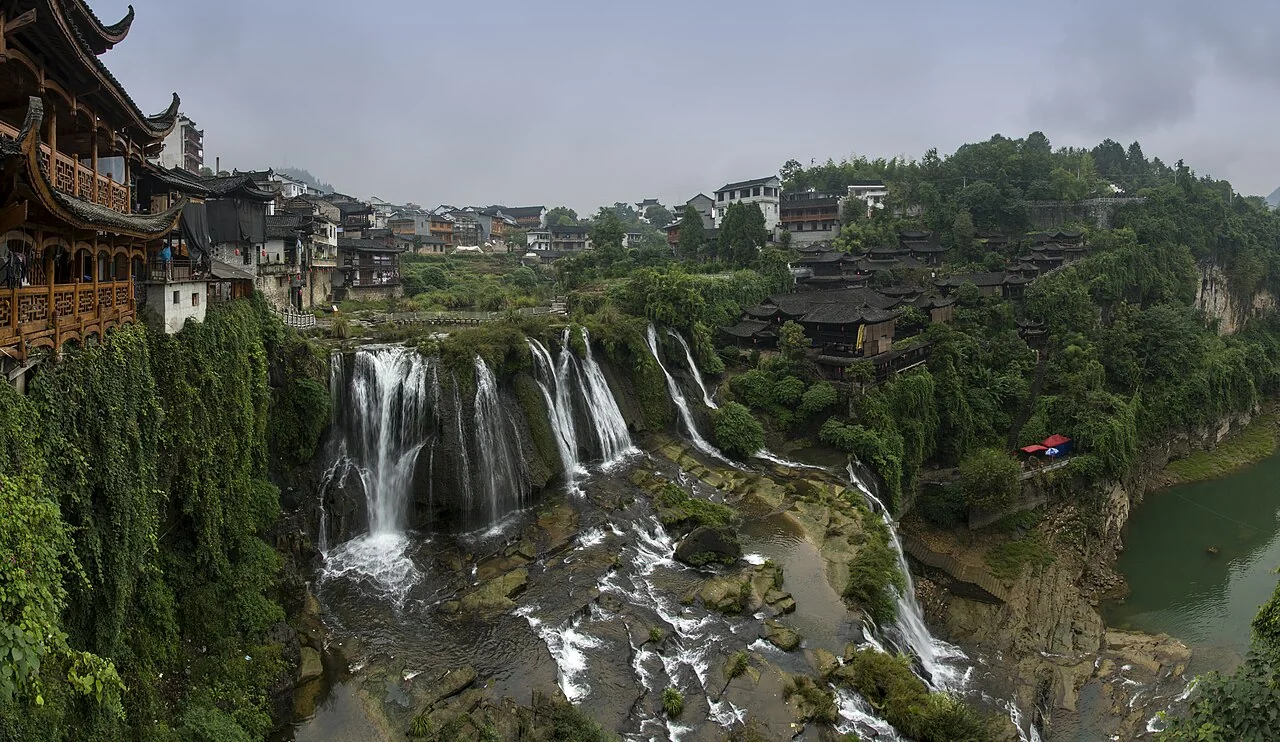
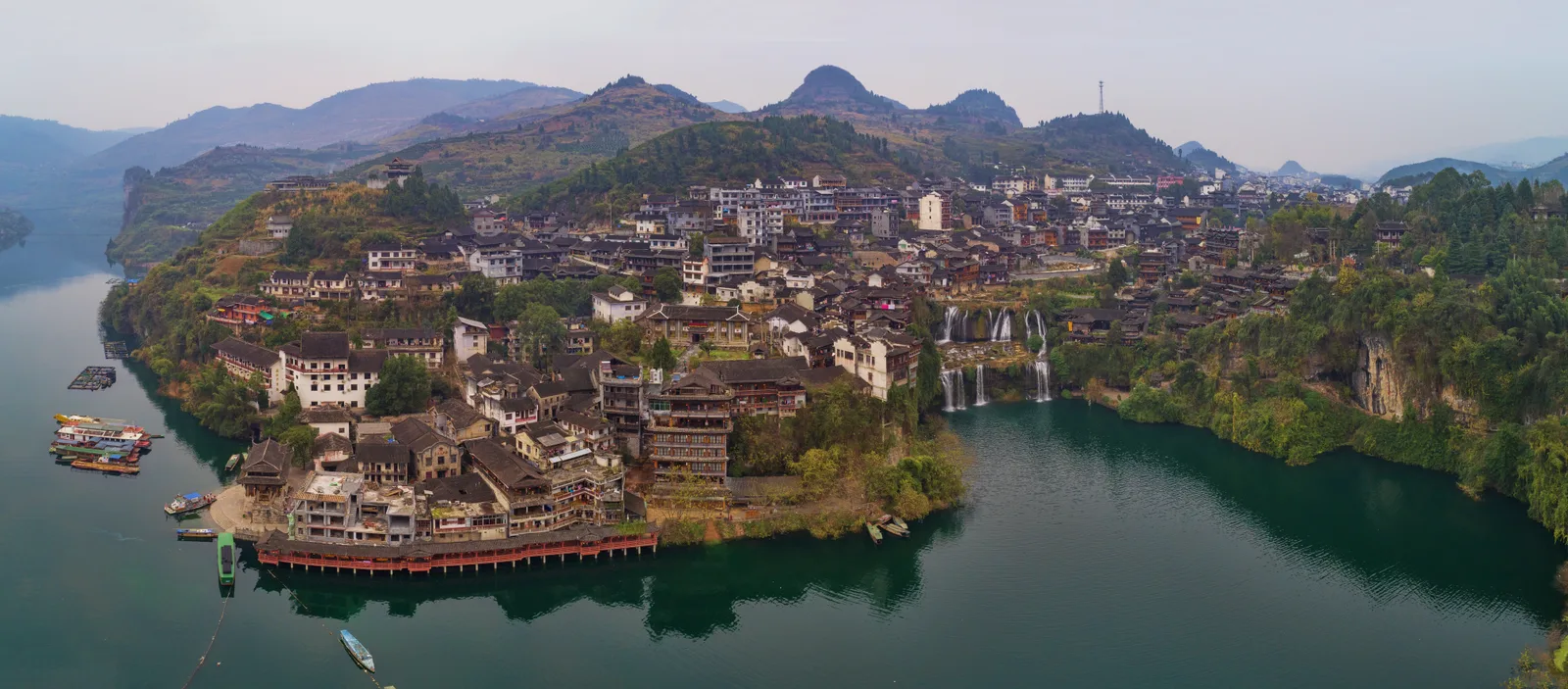
Furong Ancient Town (Furong Zhen, 芙蓉镇, also called Hibiscus Town) is a Tujia town in Yongshun County, western Hunan, built on the cliff above a waterfall about 60 m high and 40 m wide. It lies about halfway between Zhangjiajie and Fenghuang and has its own high-speed rail station 2.5 km away. Entry is ticketed, at about RMB 100–108 for an adult with the evening show, and the town stays open from 08:00 to midnight. The lights come on at about 19:30, so arrive in the afternoon and stay the night.
What is Furong Ancient Town?
Hunan’s provincial government describes it as a town with more than 2,000 years of history and calls it “an ancient town hanging on the waterfall”. It was once a seat of the Tusi, the hereditary chieftains who ruled this part of south-west China for the imperial court. The town used to be called Wangcun. Director Xie Jin shot the 1986 film Hibiscus Town here, with Liu Xiaoqing and Jiang Wen, and the town later took the film’s name. Official pages give 1997 or 2007 for the renaming, so we do not state a year. Today it is a national 4A scenic area.
It is no longer a quick stop on the road. The Paper reported in August 2026 that the town received 6.53 million visits in 2025, that evening visitors rose from 45% of the total in 2023 to 72% in 2025, and that foreign visitors grew 57% in a year. Opening hours were extended from 18:00 to midnight.
What to see
| Sight | What it is | How to use it |
|---|---|---|
| The waterfall | A stepped fall about 60 m high and 40 m wide that drops through the middle of town, with Tujia stilt houses on the cliff beside it | See it once in daylight and again after the lights come on; the waterfall pier is one of the three main evening viewpoints |
| Wuli Flagstone Street | A 2,500 m street paved with green flagstones and lined with wooden houses and shops | The spine of the town, and where to try rice tofu, the snack that appears in the film |
| Tuwang Bridge | A bridge in the old town | Named with the pier and the flagstone street as a main evening spot |
| Xizhou bronze pillars | Pillars on the Mengdong River marking a truce between Chu and Xizhou; CGTN notes that the ones on show are replicas | For visitors interested in Tusi history |
Tickets and opening hours
- Hours: 08:00 to midnight, on the Ctrip listing in October 2026.
- Price: we found no official price list. In October 2026 Qunar listed the adult ticket with the evening show at RMB 100 and Ctrip listed RMB 108, so expect RMB 100–108 depending on the channel.
- Foreign visitors: Qunar lists a ticket for non-mainland visitors at the same RMB 100. Bring your passport.
- Concessions listed: children under 1.2 m free; from 1.2 m to under 14, ages 14–18 and full-time students RMB 60 with the show; ages 65–74 RMB 10 and 75 and over free, both without the show. Ask whether a passport is accepted for the one you need.
- Ticket office: 0743-5854532. Check the price and the show time on the day you book.
Why stay for the evening
The lights on the waterfall and the stilt houses come on at about 19:30, and this is what most visitors now come for: nearly three in four arrive for the evening. The Paper names Tuwang Bridge, the waterfall pier and Wuli Flagstone Street as the three main evening spots. The town has about 200 guesthouses and more than 7,000 beds, so a night here is easy to arrange and saves a late drive.
Getting there from Zhangjiajie and Fenghuang
- By high-speed train: Furongzhen station is on the Zhangjiajie–Jishou–Huaihua line, which opened on 6 December 2021. It is the first station south of Zhangjiajie West and three stations north of Fenghuanggucheng.
- From the station: it is 2.5 km from the town, and the scenic area runs shuttle vehicles.
- Not every train stops at Furongzhen. Check the stop and the time on 12306 for your date.
- By road: CGTN put the direct bus from Zhangjiajie at about 1.5 hours in 2019. A private car lets you carry luggage between hotels.
How long, and Furong or Fenghuang?
- Time needed: an afternoon and an evening. One night is enough.
- Furong is small and ticketed, and everything is built around one waterfall.
- Fenghuang is a larger river town with free public streets and needs one or two nights.
- They are on the same railway line, so most routes from Zhangjiajie take Furong first and finish in Fenghuang.
- The real Tusi capital, Laosicheng, is a separate site in the same county and part of the UNESCO Tusi Sites listing.
Furong Ancient Town questions
Where is Furong Ancient Town?
In Yongshun County, Xiangxi Tujia and Miao Autonomous Prefecture, Hunan, about halfway between Zhangjiajie and Fenghuang.
How much is the Furong Ancient Town ticket?
About RMB 100–108 for an adult including the evening show, on Qunar and Ctrip in October 2026. We found no official price list, so confirm when you book.
What time does Furong Ancient Town open?
08:00 to midnight on the Ctrip listing in October 2026. The lights come on at about 19:30.
How do I get from Zhangjiajie to Furong Ancient Town?
Take a high-speed train from Zhangjiajie West to Furongzhen, the next station south, then the shuttle for the last 2.5 km. Or go by road, about 1.5 hours by direct bus.
Is Furong Ancient Town worth visiting?
Yes, if you can stay for the evening. In daylight it is a small town; the lit waterfall is the reason to come.
Why is it called Hibiscus Town?
Furong means hibiscus. The town was called Wangcun until it took the name of the 1986 film Hibiscus Town, which was shot here.
Sources(9)
- Furong Town: location, history, Tusi palace and the filmPeople’s Government of Hunan Province
- Ancient Charm of China: Furong Town (17 September 2019)CGTN
- Furong Town’s visitor numbers, evening share and extended hours (16 August 2026)The Paper
- Zhangjiajie–Jishou–Huaihua railway opens: station distances (6 December 2021)People’s Government of Hunan Province
- The line’s seven stations in order (7 December 2021)China News Service, from Yangcheng Evening News
- Furong Town listing: hours, concessions and phoneTrip.com Group (Ctrip)
- Tusi Sites, including LaosichengUNESCO World Heritage Centre
- Hero photo: 1 furong panorama 2012, Chensiyuan (CC BY-SA 4.0), resized by HomegroundWikimedia Commons
- Aerial photo: 1 furong aerial panorama 2017, Chensiyuan (CC BY-SA 4.0), resized by HomegroundWikimedia Commons

