
If you want to read Shen Congwen's Border Town through a place, Chadong is the stronger literary-geography choice; that is Homeground's editorial judgment, not a claim that the present town is a complete model of the novella. Choose Fenghuang for the author's birthplace, protected former residence and later memorial culture. Choose both only if you want to compare the landscape that fed the fiction with the hometown through which Shen is now remembered. The distinction matters because the story's principal ferry space is associated in scholarship with Bixiju (碧溪岨, Bìxījū), near Chadong, while Fenghuang belongs to the author's biography and the work's reception. Neither place is a life-size set preserved unchanged from the book.
Should you choose Chadong, Fenghuang or both?
Match the place to the question you are carrying
Chadong
Best for readers asking how a border river, ferry, wharf and market-town setting organize the novella. Its value is spatial comparison, not a hunt for every named object.
Fenghuang
Best for readers asking where Shen grew up, how his former home is protected and how the city commemorates him. Its lanes and Tuojiang riverfront are biographical context, not a literal novel map.
Both
Best for comparing creation and remembrance: first read the fiction against Chadong's river geography, then read Shen's life and public legacy in Fenghuang. Keep the visits conceptually separate.
Time alone should not decide. Chadong rewards a reader willing to compare text, terrain and labels even when a ferry or performance is unavailable. Fenghuang offers a denser author-and-heritage visit, but its highly visible tourism economy can encourage the false shortcut that every old-looking lane belongs to Border Town. If you have not read the novella, a summary of the ferry family, Cuicui and the border-town setting will make Chadong more legible; it still will not turn the town into proof of the fiction.
Why does the novel point toward Chadong without becoming a map of it?
The most useful correction is small but decisive: research published by Jishou University explains that the novella's main action is not simply located in the streets of Chadong. It is organized around Bixiju, described as a rock-covered hill on an upper branch of the Chadong River. Chadong remains the crucial nearby town and geographic reference, but the literary space is selected and shaped by the writer. This guide uses Bìxījū for 碧溪岨, consistent with the academic romanization “Bixiju” and the standard jū reading of 岨. Bixiju is a literary-spatial term here, not a promise of a currently signposted GPS attraction.
A novel can compress routes, move a viewpoint and make one ferry carry the emotional weight of an entire border region. That is literature, not cartographic error. In Border Town, river crossings, waiting, kinship and uncertain arrival work together. On site, therefore, ask whether the terrain helps you understand those relations. Do not ask a modern shopfront to authenticate a character or assume that a structure called Cuicui's house was occupied by a historical Cuicui. The character and plot belong to literature even when the geography draws closely on places Shen knew.
Why is Fenghuang still essential to a Shen Congwen reader?
Fenghuang's claim is biographical and commemorative. Hunan's archival biography records Shen's birth in Fenghuang in 1902; the provincial cultural-relics administration identifies his former residence as a Qing-period building included in the sixth group of nationally protected cultural sites. That gives the city a documented relationship to the author's childhood world and to the protection of his memory. It does not transfer the fictional ferry, Cuicui or Bixiju into Fenghuang.
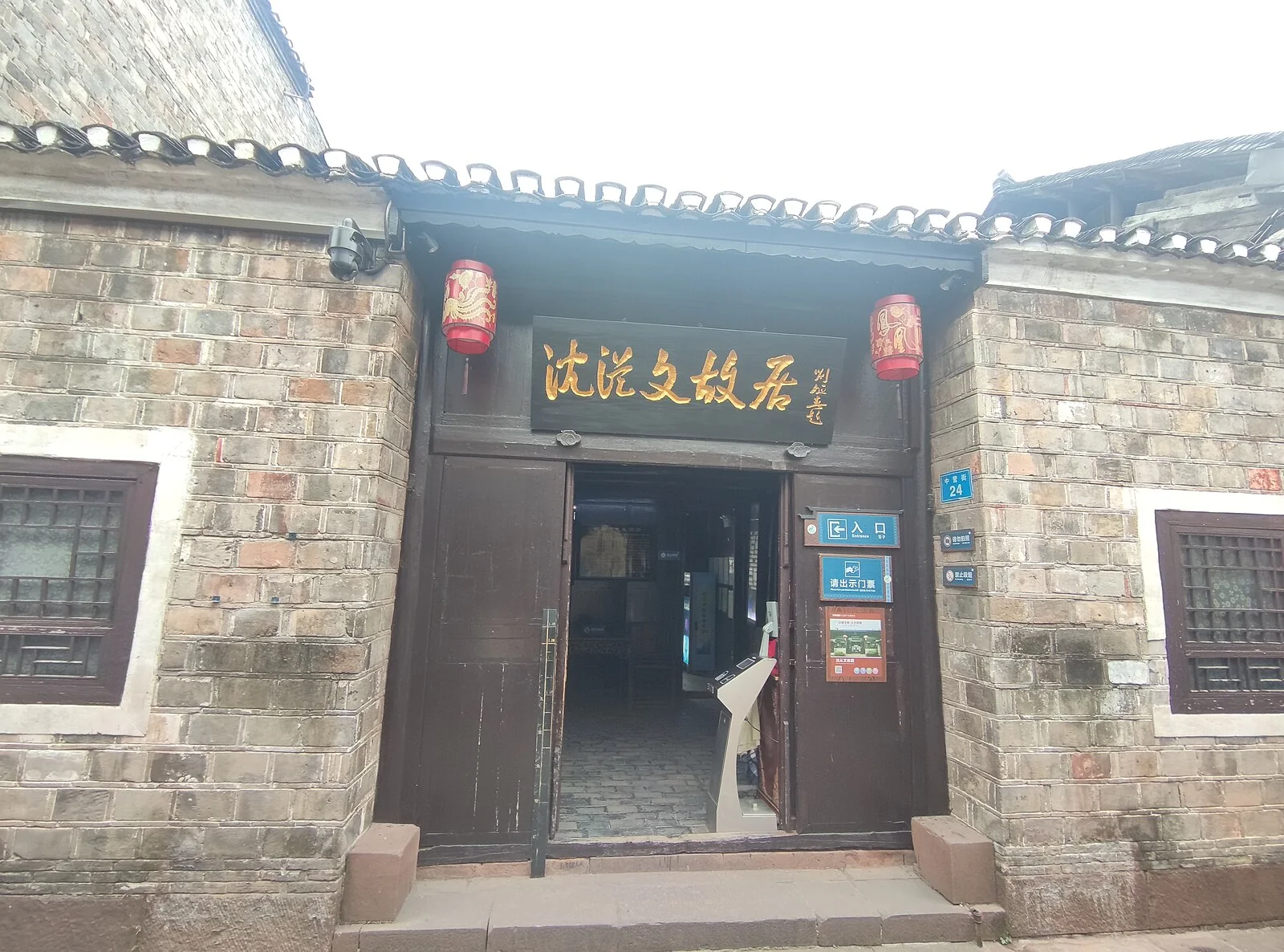
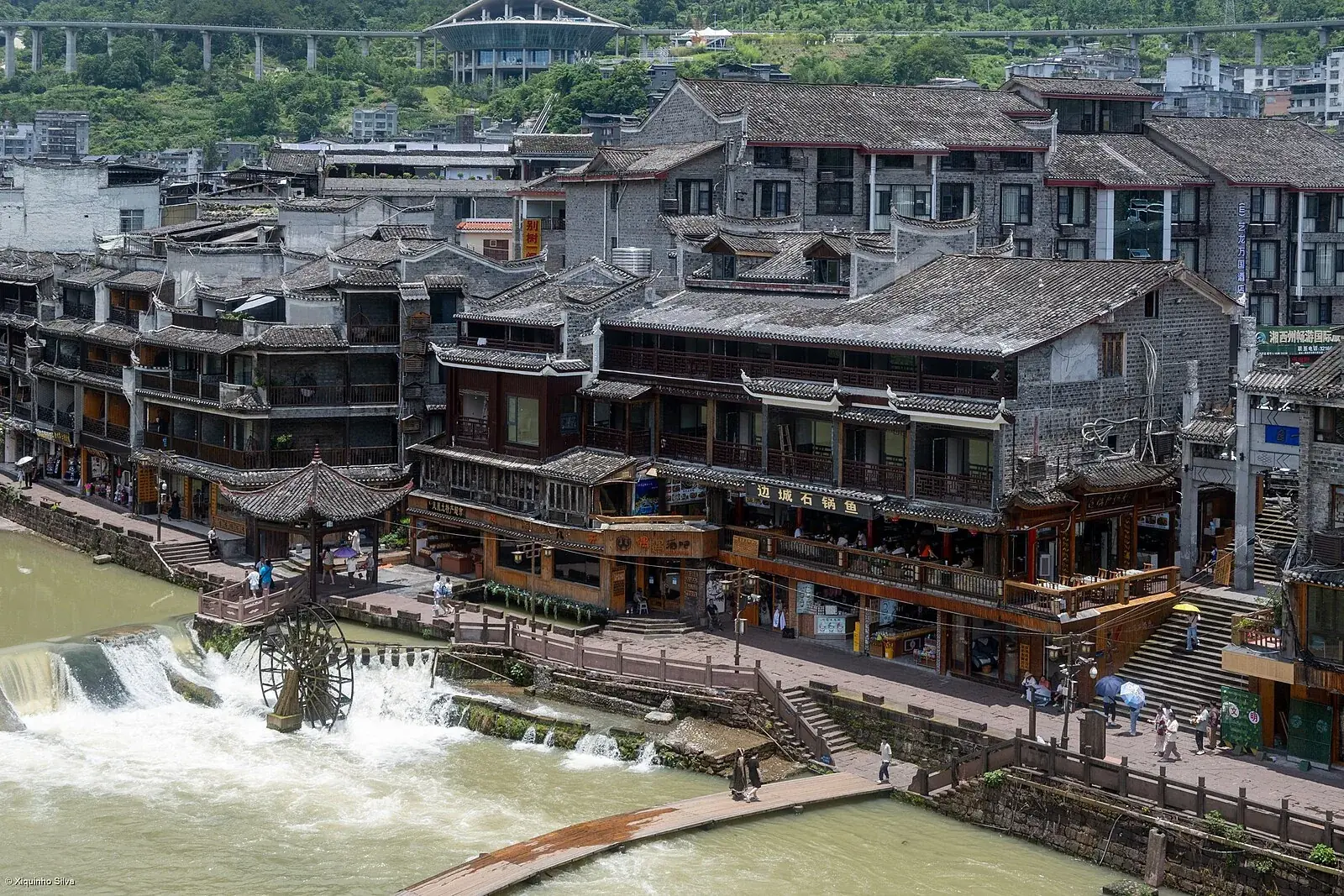
At the former residence, separate the building from what has been placed inside it. A national protection status supports the age and significance of the site as a heritage property. It does not make every beam, household object, photograph or display case original to Shen's childhood. Read three things in order: the official protection plaque, any room or conservation label, and the exhibit caption. If a label says replica, restored, reconstructed or exhibition installation, preserve that wording. If no intervention history is given, describe what you see without assigning an unsupported date.
Which layer are you looking at: history, literature, tourism or judgment?
| Layer | What belongs here | What it cannot prove |
|---|---|---|
| History | Shen's documented birth in Fenghuang; the protected former residence; a dated wharf or inscription with institutional evidence | That a fictional character lived there or that every visible component is original |
| Literature | Bixiju, Cuicui, the ferry family and the novella's organized border landscape | A precise GPS point, a historical resident or a complete town plan |
| Tourism presentation | Reconstructed character houses, performances, themed signs, renamed spaces and scenic storytelling | Direct evidence of 1930s life or the author's exact intention |
| Editorial judgment | Homeground's recommendation that Chadong better serves literary-geography readers and Fenghuang better serves author-biography readers | A scholarly consensus or an official ranking of the two destinations |
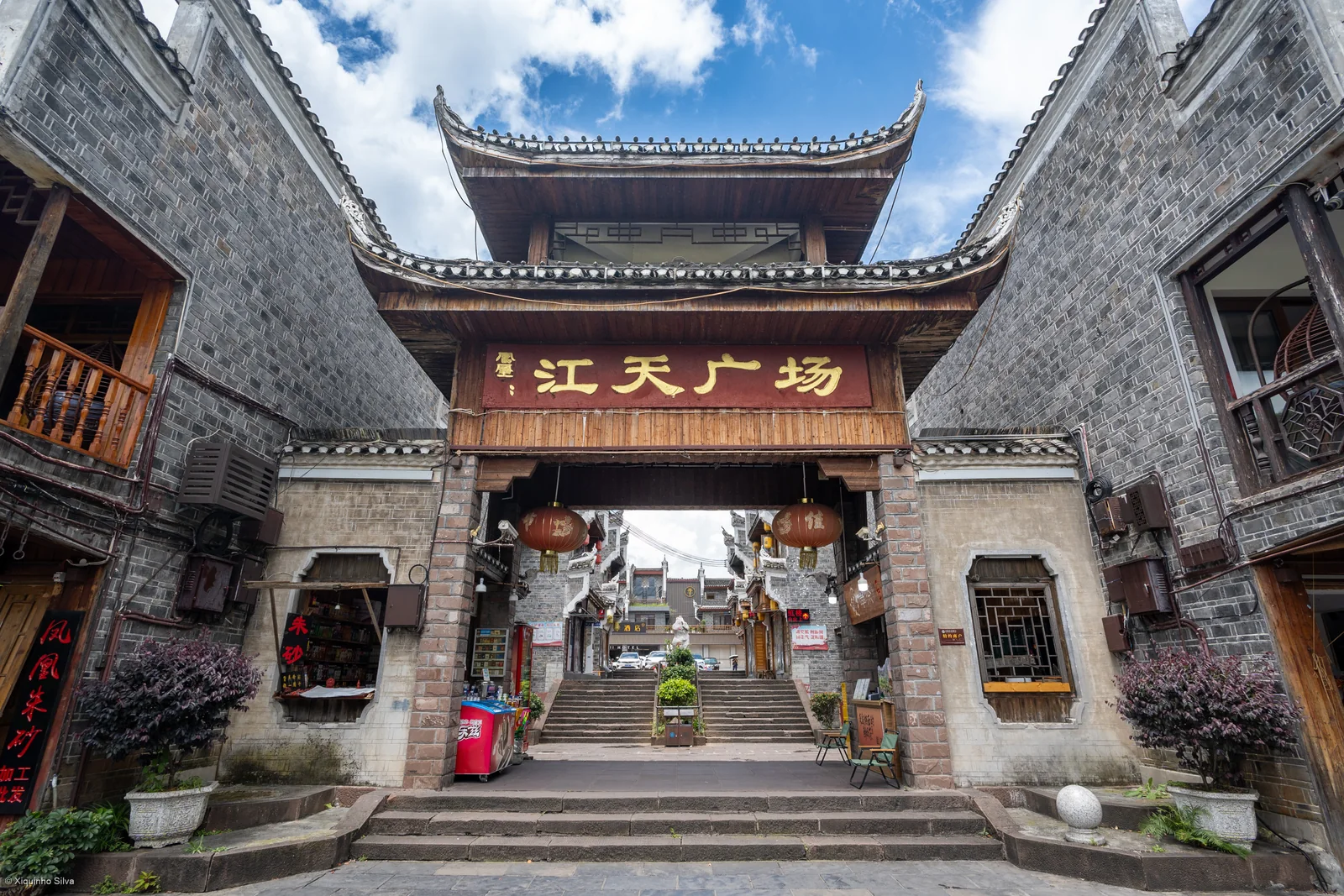
The quickest field method is to ask who is making the claim. A cultural-relics plaque can classify a protected property. A museum caption can identify an object or explain an exhibition. A tourism board can show how a destination currently presents itself. A novel creates meaning but does not certify materials. Homeground can help you choose, but an editorial recommendation must remain visibly editorial. When two layers meet in one place—an old wharf beside a themed character house—record them separately rather than averaging them into “authentic.”
How should you read Chadong on foot?
- Begin with an orientation map or an official place-name sign. Locate the Qingshui River and the meeting area of Hunan, Chongqing and Guizhou before looking for story labels. The border condition is more useful than a themed photo spot.
- Go to the Chadong Ancient Wharf on the east bank. Hunan's culture authority describes a roughly 100-square-metre, stone-stepped ferry facility dating to the Republican period and maintained after 1949; it is a protected material site, not automatically the novella's exact ferry.
- Stand where you can compare bank, landing steps and crossing distance. Ask how a ferry governs who arrives, who waits and who controls passage. If no boat is operating, the wharf and river geometry still support this reading.
- Walk the old-town streets with building-level caution. The settlement has historical depth, but one general town description cannot date every facade, timber frame or shop interior. Use individual plaques where they exist.
- Treat Cuicui-themed spaces as interpretation. A 2024 Hunan government feature explicitly describes the Cuicui residence as a reconstructed scene simulating the novella. It can show how tourism materializes a character; it cannot make Cuicui historical.
- Inspect the writing as an object with a date. The gate inscription installed in 2026 is an authorized reproduction based on a genuine Shen inscription from 1981. The large red cliff lettering dates to 1993 and was imitated by a local calligrapher. Neither is Shen's original hand physically preserved on that surface.
How should you read Fenghuang as the author's city?
- Start at Shen Congwen's former residence, not at a generic “Border Town” sign. Confirm the protection plaque and identify which rooms are building fabric, which are exhibitions and which objects carry provenance labels.
- Use the courtyard and domestic scale to think about family and early environment, but resist turning every display into a biographical relic. A caption is the bridge between an object and a claim.
- Walk the surrounding lanes as the author's hometown context. Look for street width, courtyard relationships and transitions toward the Tuojiang; do not rename them after fictional episodes unless an official or scholarly source makes that connection.
- At the Tuojiang and Hongqiao, notice the difference between enduring urban geography and a heavily managed visitor landscape. Both are real; neither proves that the fictional ferry stood here.
- If time and access permit, finish at Shen's grave or memorial landscape beside the Tuojiang. The archival biography supports this as a place of commemoration. It is optional for understanding the former home and should not be presented as a scene from the novella.
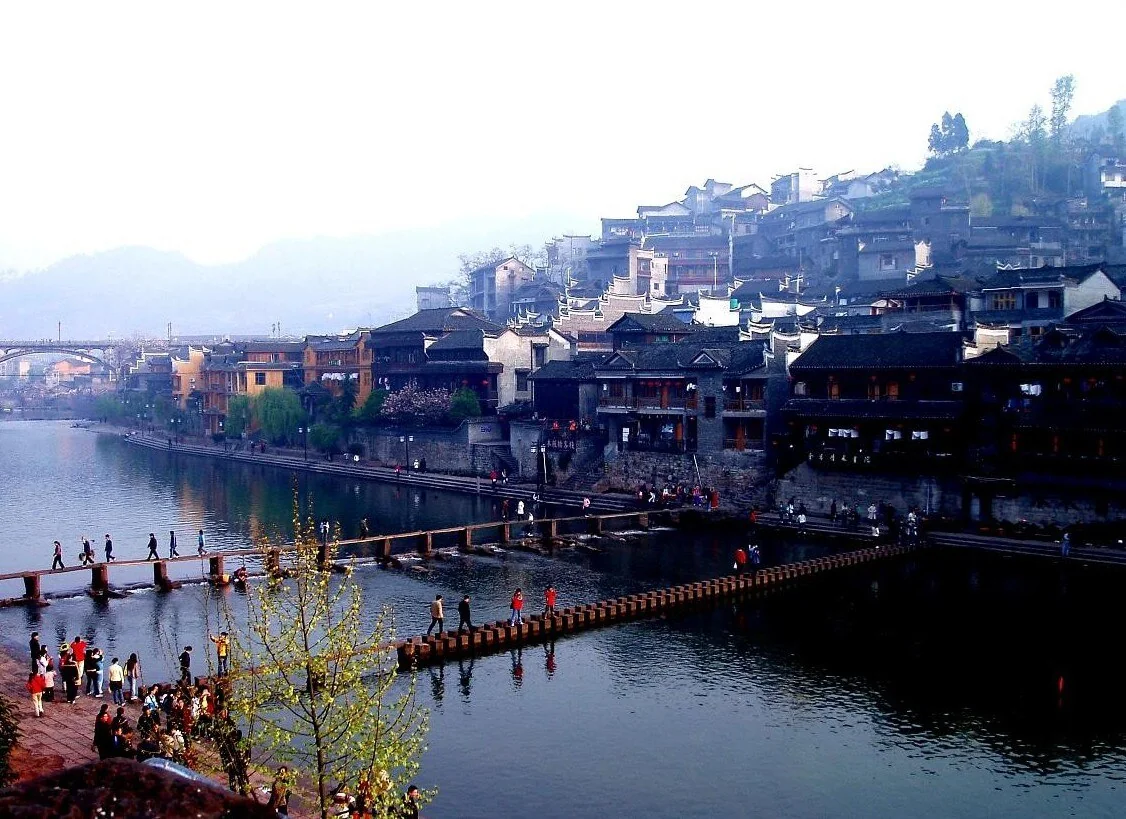
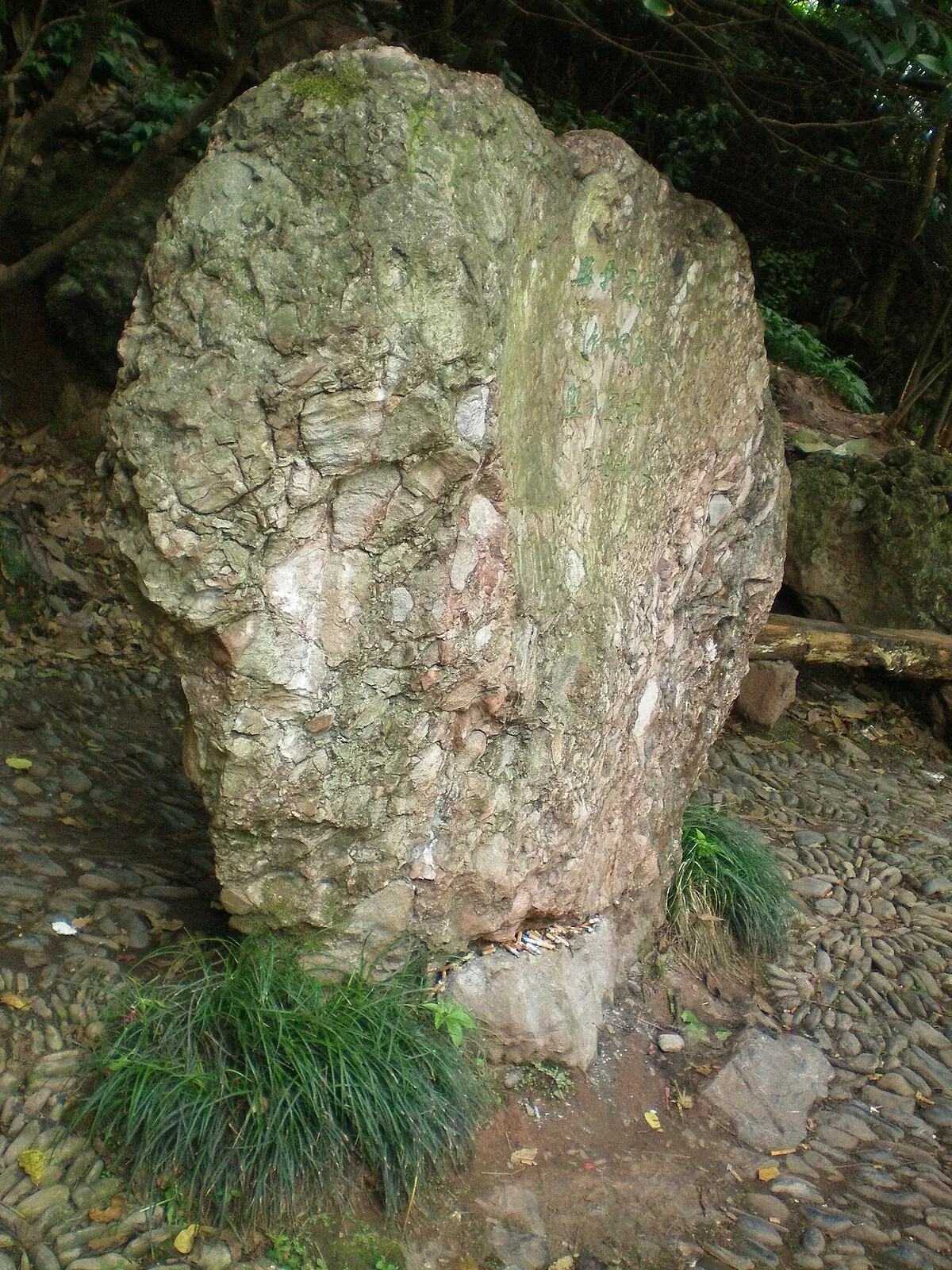
What survives, what was maintained and what was newly staged?
| Place or object | Supported status | Do not call it |
|---|---|---|
| Shen Congwen Former Residence, Fenghuang | A Qing-period, nationally protected heritage property under active conservation management | An untouched house in which every visible material and furnishing is original |
| Chadong Ancient Wharf | A protected Republican-period ferry/wharf with stone steps, recorded as maintained after 1949 | The conclusively identified ferry from the novella |
| Old streets in Chadong | A historic settlement context whose individual buildings require their own labels | A uniformly preserved 1930s streetscape |
| Cuicui residence in Chadong tourism presentation | A reconstructed scene made to simulate a space in the novella | Cuicui's historical home or a surviving original building |
| Biancheng gate lettering installed in 2026 | A modern, authorized reproduction derived from a genuine 1981 Shen inscription | The original handwritten artifact or an old gate inscription |
| Red cliff lettering | A 1993 imitation made by local calligrapher Long Qinglian | Characters written on the cliff by Shen Congwen |
| Tuojiang, Hongqiao and lanes in Fenghuang | Real components of Shen's hometown and its present visitor landscape | A certified plan of Border Town |
“Protected” and “original” are not synonyms. Protection can include repair, replacement, stabilization and new interpretation. Conversely, a modern reconstruction is not useless: it can reveal how later readers imagine the novella. The responsible question is not whether everything feels old, but which layer the object belongs to and whether its label documents material history. Photograph the full label where permitted, including the issuing body and date, rather than saving only a picturesque detail.
What visit sequence works when time or access changes?
Three workable reading routes
Literature-first, one place
- Choose Chadong.
- Orient to the river-border geography.
- Read the ancient wharf before themed spaces.
- Finish by comparing reconstruction and inscription dates.
Author-first, one place
- Choose Fenghuang.
- Begin at the former residence and its labels.
- Walk lanes toward Tuojiang and Hongqiao as hometown context.
- Add the grave only if access and interest allow.
Two-place comparison
- Give each place its own reading question.
- Use Chadong for literary geography and tourism reconstruction.
- Use Fenghuang for biography, protected heritage and commemoration.
- Do not compress both into one rushed checklist.
- If the former residence is closed, read the exterior protection information and use an official museum or cultural-relics source; do not infer interior access from an old travel post.
- If photography is restricted, write down the institution, object title and label date. A rights restriction does not reduce the evidentiary value of a properly recorded caption.
- If a Chadong ferry is not running, compare the fixed wharf, banks and crossing line. Do not substitute an unrelated boat ride and call it the literary ferry.
- If a themed sign contradicts a heritage plaque, preserve both claims and give the heritage or scholarly source priority for historical status.
- If a building has no date or conservation label, call it a building in the present town—not an original, restoration or reconstruction.
- If current opening, ticketing or performance information cannot be confirmed, keep the route exterior-first and ask the official operator locally on the day.
Who should go, who can skip, and what must be rechecked?
- Choose Chadong if you have read the novella and want landscape, border and ferry relations more than a conventional author museum.
- Choose Fenghuang if Shen's biography, a protected residence and memorial culture matter more than locating the fiction's river structure.
- Choose both if the difference between a work's geographic imagination and an author's later public memory is the point of your trip.
- Skip the extra literary detour if you mainly want transport, accommodation or a general ancient-town itinerary; existing Homeground destination guides handle those tasks better.
- Before departure, recheck only dynamic items with the direct operator: access to the former residence, photography rules, any ferry operation and any advertised performance. Keep a route that works without them.
Questions readers ask about Chadong and Fenghuang
Is Fenghuang the real-life setting of Border Town?
No. Fenghuang is Shen Congwen's birthplace, with his protected former residence and later memorial culture, while the novella's principal ferry space is associated in scholarship with Bixiju (碧溪岨), near Chadong. Fenghuang belongs to the author's biography and the work's reception, and neither place is a life-size set preserved unchanged from the book.
Is Chadong the same place as Biancheng?
Yes, they are the same town. The administrative town formerly called Chadong was renamed Biancheng in 2005. That change demonstrates the modern public association between the town and the novella; it does not prove that today's boundaries, streets and attractions duplicate the fictional space.
Can I cross the river by ferry at Chadong?
Treat it as unconfirmed. No stable official notice reviewed for this article establishes a daily tourist-ferry timetable, fare or performance schedule, so recheck the town or venue's same-day notice. If a crossing is unavailable, the protected wharf, the riverbanks, the orientation signs and the reconstruction labels still carry the literary reading.
Is the Cuicui residence in Chadong a real historical house?
No. A 2024 Hunan government feature explicitly describes the Cuicui residence as a reconstructed scene simulating the novella, so read character-themed spaces as interpretation rather than evidence. They show how tourism materializes a character into a place you can walk into; they cannot make Cuicui historical.
Do I need to read the novella before I go?
It helps, but it is not required. A summary of the ferry family, Cuicui and the border-town setting will make Chadong more legible, and the town rewards a reader willing to compare text, terrain and labels even when a ferry or performance is unavailable. A summary still will not turn the town into proof of the fiction.
Is everything inside Shen Congwen's former residence in Fenghuang original?
Not all of it. National protection status supports the age and significance of the site as a heritage property, but it does not make every beam, household object, photograph or display case original to Shen's childhood. Read three things in order: the official protection plaque, any room or conservation label, and the exhibit caption. If a label says replica or restored, preserve that wording.
Sources and image credits reviewed through 14 August 2026(20)
- Shen Congwen biographyHunan Provincial Archives
- Shen Congwen Former Residence in Hunan's national protected-site listHunan Provincial Cultural Relics Bureau
- 2025 protection inspection of Shen Congwen Former ResidenceHunan Provincial Cultural Relics Bureau
- A Trinity View of the Literary Geography of Border TownJournal of Jishou University
- Spatial Production of the Ancient Town of ChadongJournal of Jishou University
- Chadong Ancient WharfHunan Department of Culture and Tourism
- Chadong tourism presentation and reconstructed Cuicui residenceHunan Provincial People's Government
- Provenance of the 2026 gate and 1993 cliff letteringHunan Provincial People's Government
- Chadong/Biancheng place-name historyHunan Department of Civil Affairs
- Dated 2025 scenic-area operation and public-performance snapshotHunan Department of Culture and Tourism
- Standard reading table for 岨Ministry of Education, Taiwan
- Hero: Hongqiao in Fenghuang by xiquinhosilva; cropped, CC BY 4.0Wikimedia Commons
- Shen Congwen Former Residence entrance by Kurgenera; resized, CC BY-SA 4.0Wikimedia Commons
- Fenghuang Tuojiang rooftops by xiquinhosilva; resized, CC BY 4.0Wikimedia Commons
- Jiangtian Plaza gateway by xiquinhosilva; resized, CC BY 4.0Wikimedia Commons
- Tuojiang stepping stones by Yu Hui; converted at native size, CC BY-SA 2.0Wikimedia Commons
- Shen Congwen grave by Zhangmoon618; resized, public-domain dedicationWikimedia Commons
- CC BY 4.0 licenceCreative Commons
- CC BY-SA 4.0 licenceCreative Commons
- CC BY-SA 2.0 licenceCreative Commons


