

The carved face in Anshun Dixi is not being worn incorrectly. A performer covers their own face with a qingjin head cloth while the wooden lianzi sits above it; character then emerges through carving, voice, group response, gong, drum, weapon and full-body movement. That arrangement is easy to see. Why it first developed is not settled historical fact. Read the whole performance system before trying to decode one colour or invent one origin story.
First identify the form: Anshun Dixi
China's national intangible-cultural-heritage register lists Anshun Dixi as traditional-theatre project IV-90, first listed in 2006, with Anshun Culture Center as the protection unit. The official description places it in Anshun's Tunpu military-colony context and records the visible grammar: a qingjin covering the head and face, a mask on the forehead, a battle skirt, weapons, sung narration, one lead answered by the group, and accompaniment by one gong and one drum. These features provide a reliable observation framework; the heritage label does not mean every village troupe, tourist excerpt or new choreography has the same duration, cast or purpose.
Military-colony context is established; one exact birth date is not
Anshun's Tunpu communities are historically connected with Ming military settlement, and the martial repertoire and performance vocabulary are meaningfully read against that background. Do not turn that context into a claim that today's Dixi is an unchanged Ming military drill. Guizhou University research notes that no documentary record fixes the form's date of formation and that proposals range across several periods. The honest conclusion is narrower: military-settlement history matters, while the precise origin and every later transformation remain research questions.
Why is the lianzi above the performer's face?
Separate what the evidence can answer. It can establish the convention: official records describe the performer covering the head and face with a qingjin and placing the carved mask on the forehead. It can preserve a living explanation: in a 2025 interview, practitioner Gu Jiashun said this position expresses respect for the character. It cannot yet establish one original cause accepted across history and scholarship. Practical observations—what the audience can see, where the voice travels, or how the performer looks beneath the rim—should not be promoted into origin proof unless a qualified source documents that claim.
Read six channels together, not six isolated symbols
| Channel | What to watch | What it contributes | Do not assume |
|---|---|---|---|
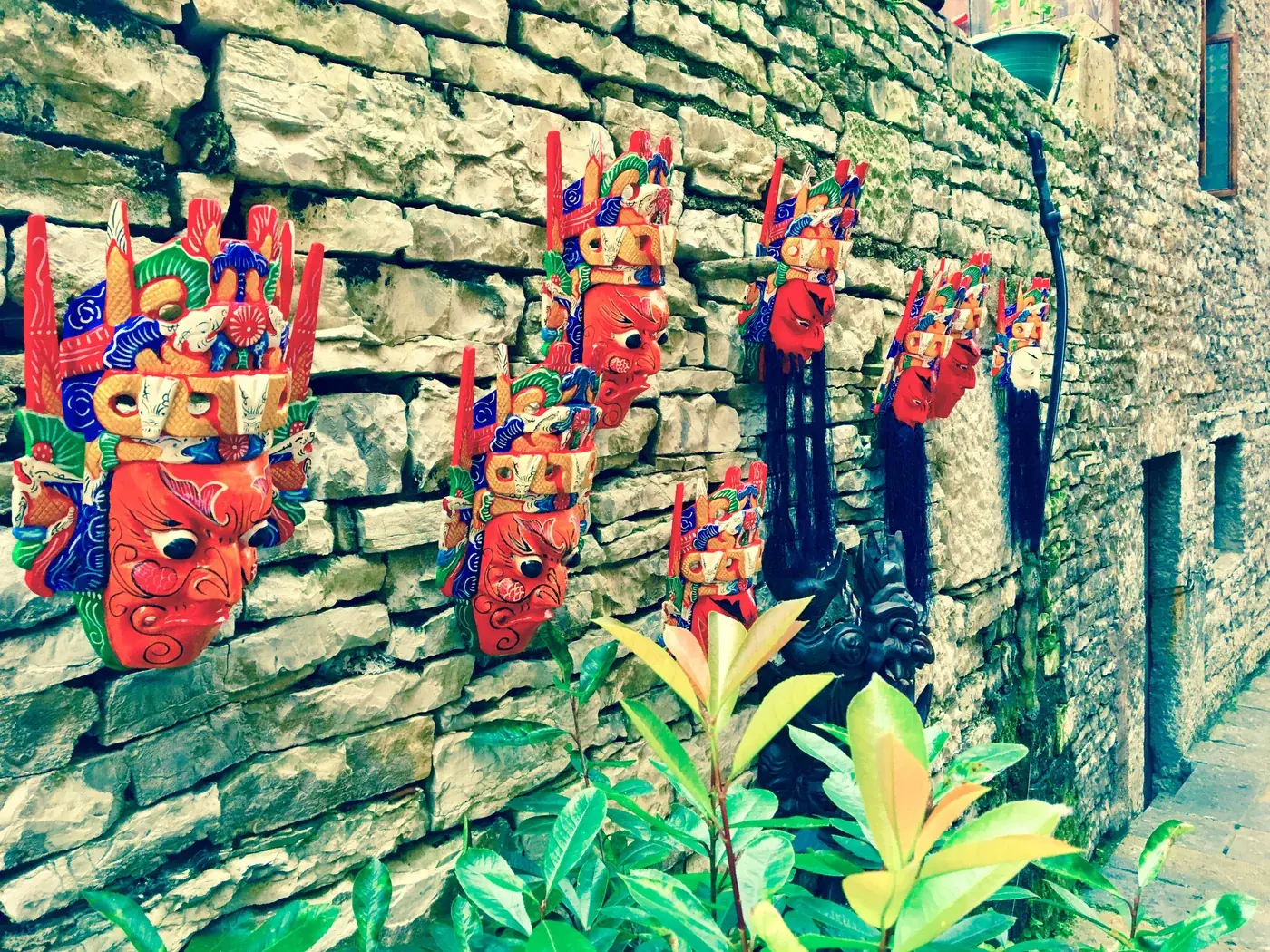
| Lianzi (carved face) | Silhouette, carved expression, headgear, ears, beard and the angle above the qingjin | Makes a role legible at a distance and holds a fixed visual identity while the body moves | That one colour has the same universal meaning in every troupe or that appearance proves age |
| Qingjin head cloth | How the performer's face and neck recede while breath, sight and movement continue | Separates the visible character-face from the individual face beneath it | That concealment erases the performer or supplies a complete explanation of ritual meaning |
| Lead and group response | Who advances the narration and when the surrounding voices answer | Turns story into a collective acoustic structure rather than a solo aria | That an unfamiliar language makes the sound secondary or that every line belongs to one role |
| Gong and drum | Beginnings, stops, changes of pace, entrances and combat accents | Organizes attention and physical timing with a deliberately compact sound world | That louder or faster automatically means a climax |
| Weapons and back flags | Direction, reach, spacing, balance and the delay of flexible elements after a turn | Extends the body's line and makes martial relationships readable | That a stage weapon documents historical military equipment or may be handled by visitors |
| Whole body and circle | Weight shifts, footwork, approach and retreat, partner distance and the audience boundary | Supplies expression that the fixed carved face cannot change moment by moment | That a short excerpt reproduces the social and ritual space of a village performance |
Use five attention passes during a first performance
- For the first minute, watch the face-above-face arrangement. Notice when your attention lands on the carving and when the qingjin-covered body takes over.
- Choose one performer and follow the connection from foot to torso, weapon, back flags and lianzi through one turn or exchange.
- Listen for a complete lead-and-response unit. Mark where the gong or drum begins, interrupts or releases the movement.
- Find one relationship between characters: challenge, advance, retreat, protection or confrontation. Use spacing and response before guessing names.
- Only after those passes, consult the named work or synopsis. Correct your reading with programme evidence rather than forcing every gesture into a familiar story.
Read role families without importing a universal colour code
Research and practitioner descriptions group many Dixi faces around role families such as civil, martial, older, younger and female generals, with additional figures depending on the repertoire. That gives you a question, not a lookup chart: what carving, headgear, beard, posture and action distinguish this role in this named work? Do not map Peking-opera face-paint rules directly onto a wooden lianzi. Ask for the work title, role name and troupe's own explanation when a precise identification matters.
The stories are heroic literature, not primary historical records
The national heritage record names heroic-war traditions associated with the Three Kingdoms and the Yang and Yue generals among the repertoire. Watch how a scene distributes loyalty, command, confrontation and return; a short synopsis will often help more than a long dynastic timeline. A performed character may be based on history, legend, popular fiction and local transmission at once. Use the title of the actual book, episode or excerpt, and do not cite stage action as evidence that an event occurred exactly as performed.
Dixi and Nuo: keep the relationship without an equals sign
The national register gives Nuo theatre project number IV-89 and Anshun Dixi IV-90. That establishes separate official project identities, not total cultural isolation. Academic discussion has long included opposing classifications—one influential title argues Anshun Dixi is not Nuo theatre, while another frames Guizhou Dixi as military Nuo. A Guizhou University book introduction also discusses Dixi in relation to a wider Nuo-ritual prototype. For a visitor, retain the local name Anshun Dixi, describe the features you can evidence, and avoid presenting either broad equivalence or complete separation as settled consensus.
Do not ask one setting to stand in for every Dixi context
Four related but different settings
Village ritual sequence
- Organized through a community and troupe relationship
- May include opening, performance and closing phases beyond the dramatic action
- Not a drop-in tourist product or an invitation to enter private ritual space
Tianlong visitor excerpt
- A recent official feature described timed excerpts of about ten minutes
- Useful for first recognition of mask, sound and movement
- Not a substitute for a full village sequence and not guaranteed for your arrival time
Invited public presentation
- May be adapted to a festival, theatre, school or public programme
- Name the organizer, troupe, work and stated format
- Judge the announced presentation rather than calling it automatically complete or false
Contemporary creation
- May use Dixi masks, movement or sound within new choreography
- Credit the contemporary work and its makers
- Do not label a new creation as an unchanged village ritual
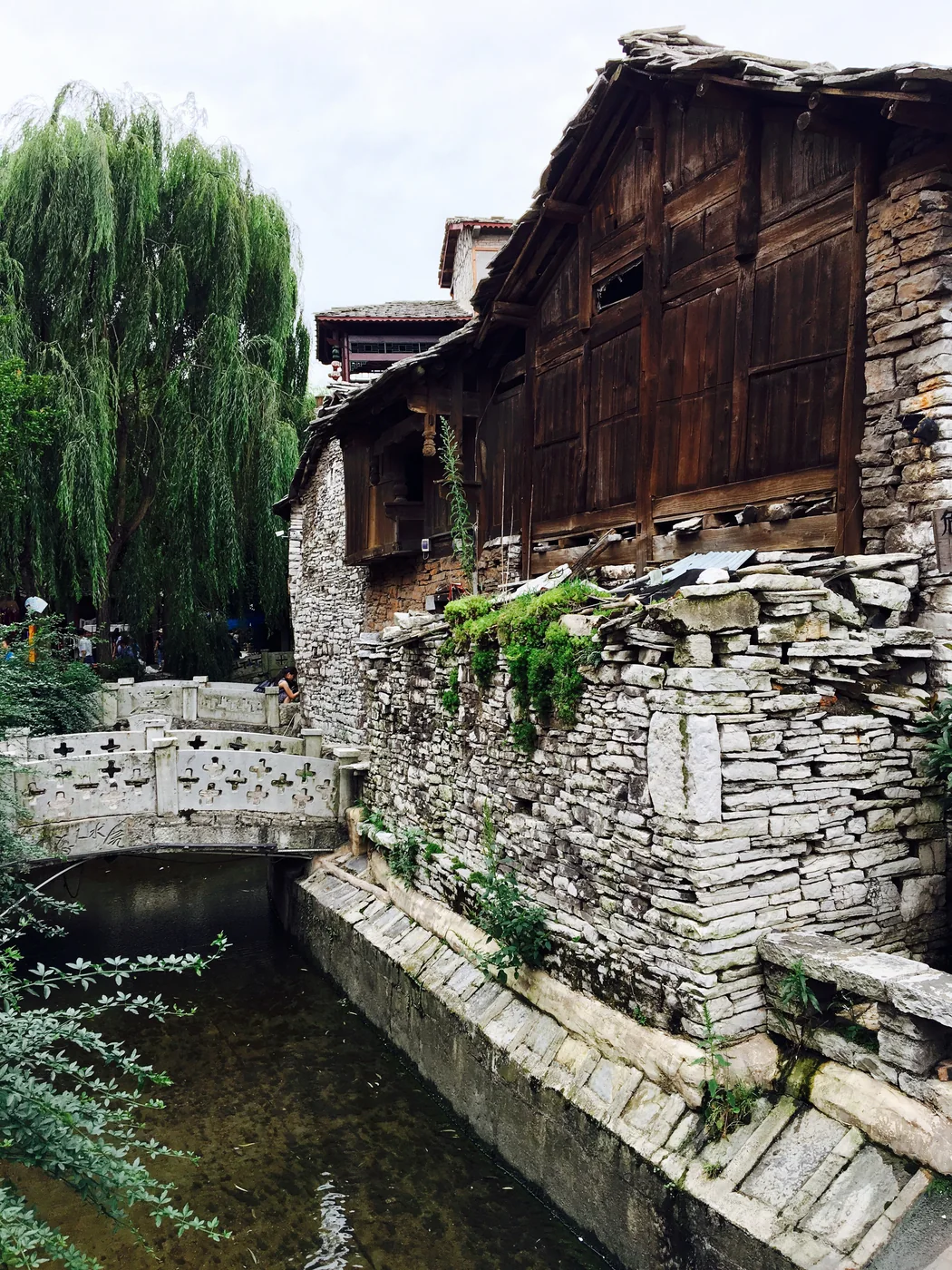
The distinction is not a simple real-versus-fake ranking. Peer-reviewed research at Tianlong documents how tourism moved performance through different spaces and changed relationships among performers, community and operator; it records a purpose-built Yanwutang completed in 2009 after earlier venues. That history shows why place, duration, audience and institutional setting belong in your description. A visitor excerpt can be a legitimate point of access while still being a different social event from a village ritual sequence.
Before going, verify only what your decision needs
- Ask whether the current item is a Dixi excerpt, a full staged work, an interpretation session or no performance that day.
- Record the date, exact venue, announced duration and named operator source. A copied schedule or old holiday report is not current confirmation.
- If a ticket description says Dixi is included, keep performance availability separate; inclusion does not establish a show at every arrival time.
- Ask for the Chinese work or episode title and whether a synopsis or spoken introduction is available. Do not assume English or Korean support.
- Check current photography and recording rules on site. This guide does not claim that a ticket, public setting or past visitor photograph grants permission.
- Keep a fallback that is worthwhile without a performance. If the show is the only reason for the trip, wait for direct confirmation rather than building the day on an inference.
If there is no performance, do not manufacture one from a display
| What happens | Useful next move | Boundary to retain |
|---|---|---|
| No current performance can be confirmed | Treat Tianlong as a public-place visit only if that still suits your route; otherwise skip it | Do not call a rehearsal, shop display or old video today's show |
| You see displayed masks without an object label | Describe only visible carving and the dated place; look for maker, role and display-owner records | Do not infer age, ritual use or a specific character from colour alone |
| The excerpt is shorter than expected | Name its announced format and use the six-channel observation frame | Do not claim that a short excerpt reproduces a full village sequence |
| The story is difficult to follow | Identify one relationship, one response pattern and one movement phrase, then check the title | Do not invent a translation from costume or facial expression |
| Photography is restricted or unclear | Put the camera away and use an authorized programme or licensed image later | Do not treat admission as consent or publication permission |
Observation is not access to every layer of the practice
Leave with a six-line evidence note
- Exact setting: village sequence, visitor excerpt, invited programme or contemporary creation.
- Date, venue, organizer or troupe, and the current source that announced it.
- Named work, episode or the honest note that the title was unavailable.
- One observed connection among lianzi, qingjin, voice, percussion, weapon and body.
- One statement from a programme, practitioner or label, kept separate from your own observation.
- Any unresolved question—role identity, mask maker, permission or schedule—left unresolved rather than guessed.
Questions first-time Dixi audiences ask
Is the mask being worn wrong when it sits on the performer's forehead?
No. The performer covers their own head and face with a qingjin head cloth, and the carved lianzi sits above it on the forehead. Character emerges only when carving, voice, group response, gong, drum, weapon and full-body movement work together. The arrangement is easy to see, but why it first developed is not settled historical fact, so treat any single origin story with care.
How long is the Dixi excerpt at Tianlong?
About ten minutes. A National Ethnic Affairs Commission feature dated 3 July 2026 reported that Tianlong's Yanwutang gave timed daily Dixi excerpts of about ten minutes, as checked on 15 August 2026. It published no clock times, cancellation rule or language support, so check the same day's programme and exact venue with the current operator.
Is the ten-minute tourist excerpt the same as Dixi in a village?
Not the same social event, and the difference is not a real-versus-fake ranking. Peer-reviewed research at Tianlong documents how tourism moved performance through different spaces and changed relationships among performers, community and operator. A visitor excerpt can be a legitimate point of access while still differing from a village ritual sequence, so record the place, duration, audience and institutional setting.
Can I tell which character a mask shows from its colour?
Not from a colour chart. Research and practitioner descriptions group many Dixi faces into role families such as civil, martial, older, younger and female generals, which gives you a question rather than a lookup table, and Peking-opera face-paint rules do not transfer to a wooden lianzi. Ask for the work title, role name and the troupe's own explanation when a precise identification matters.
Are the Dixi stories real history?
They are heroic-war literature, not primary historical records. The national heritage record names heroic-war traditions associated with the Three Kingdoms and the Yang and Yue generals among the repertoire. One performed character may draw on history, legend, popular fiction and local transmission at once, so do not cite stage action as evidence that an event occurred exactly as performed.
Can I photograph the performance or handle the masks?
Ask first. Do not handle a lianzi, weapon, costume chest or ritual object unless the responsible practitioner explicitly invites it, and do not enter a village event merely because it is visible from a public path. Ask again before making an identifiable portrait, recording a full performance or reproducing a programme: venue rules, participant consent and copyright are separate permissions.
Official, protection-body, academic and image sources reviewed(13)
- Anshun Dixi — national intangible-cultural-heritage project IV-90China Intangible Cultural Heritage
- Nuo theatre (Linwu Nuo) — national project IV-89China Intangible Cultural Heritage
- Social and cultural interpretation of Anshun DixiGuizhou University — Zhang Dinggui
- Tunpu Dixi and Tunpu society: a ritual perspectiveGuizhou University Press
- From ritual to presentation: changing functions of Tunpu DixiJournal of Guizhou Minzu University, 2025 issue 1
- Tourism and the production of traditional ritual space at TianlongActa Geographica Sinica, 2020
- Anshun Tunpu and the recent Tianlong visitor excerptNational Ethnic Affairs Commission / China Ethnic News
- Named practitioner interview with Gu JiashunGuiyang Daily, 4 June 2025
- Hero image: masked Dixi performers in a Guizhou Tunpu villageYinwang888 / Wikimedia Commons — CC BY-SA 4.0
- Image: Tianlong tourism-space mask displayHuangdan2060 / Wikimedia Commons — CC BY 3.0
- Image: public lane at Tianlong TunpuHuangdan2060 / Wikimedia Commons — CC BY 3.0
- CC BY-SA 4.0 license used for the hero photographCreative Commons
- CC BY 3.0 license used for the two Tianlong photographsCreative Commons

